
Hashprice Near $30 Puts Bitcoin Mining Back on an Efficiency Test
Bitcoin miners are built for volatility. They expect it, price it in, and live with it through every market cycle.
But the latest pressure on mining is not just another Bitcoin price story.
It is a hashprice story.
Bitcoin miners are built for volatility. They expect it, price it in, and live with it through every market cycle.
But the latest pressure on mining is not just another Bitcoin price story.
It is a hashprice story.
According to CoinDesk, citing a recent JPMorgan report, Bitcoin’s mining network has become more sensitive to price swings as more miners operate close to breakeven. JPMorgan said mining difficulty has become more responsive to BTC price moves this year, with the beta of mining difficulty relative to Bitcoin price changes rising to 0.62 over the past six months.
That may sound like a technical footnote. It is not.
When margins get thin, miners react faster. A price move that might have been absorbed in a stronger market can push higher-cost operators closer to shutting machines down. When enough hashrate leaves the network, difficulty adjusts.
Bitcoin is designed to do that. The more interesting question is how quickly miners are being forced to respond.
BTC Price Gets the Attention. Hashprice Runs the Business.
Most people watch the Bitcoin price.
Miners watch hashprice.
Hashprice measures how much revenue a miner can expect from a unit of hashrate over a given period. In practical terms, it tells miners what their machines are earning before electricity, hosting, maintenance, financing, cooling, and downtime.
That is why the BTC price chart never tells the whole mining story.
Bitcoin can be up, but miners can still feel pressure if difficulty rises faster, transaction fees fall, or network competition gets heavier. Bitcoin can be down only modestly, but if machines are already near breakeven, that move can hit operations fast.
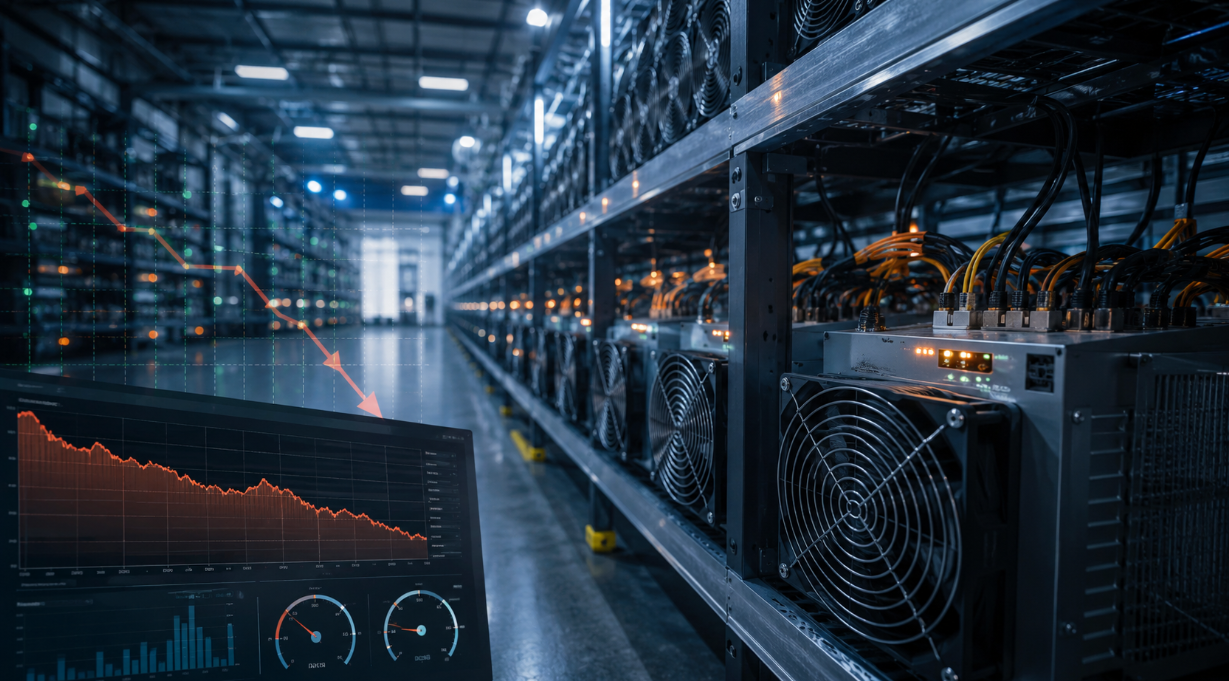
At the time of writing, Hashrate Index showed Bitcoin hashprice near $30 per PH per day, with network hashrate around 972 EH/s. Those numbers move constantly, but the message is clear enough: Bitcoin mining is still a scale business, but scale alone is not enough.
Efficiency is doing more of the work now.
Near Breakeven, Small Changes Matter
Mining is simple in concept and unforgiving in practice.
A miner contributes SHA-256 hashrate to the Bitcoin network. In return, the miner competes for block rewards and transaction fees. Against that revenue sit the real costs: machines, power, infrastructure, cooling, maintenance, capital, and downtime.
The gap between those two sides is the business.
When hashprice is strong, the market is more forgiving. Older machines can stay online longer. Expensive power is easier to tolerate. Operational mistakes do not hurt as much.
When hashprice falls, the cushion disappears.
A few cents per kilowatt-hour can decide whether a machine stays profitable or turns into a liability. Poor cooling becomes a cost. Downtime matters more. Firmware stability matters more. Power efficiency matters more. Every watt has to earn its place.
That is the part many Bitcoin price discussions miss.
Miners do not operate inside a chart. They operate inside power markets, facility constraints, hardware efficiency curves, and difficulty adjustments.
This is also why some large mining companies have been exploring AI and high-performance computing. Longer-term compute contracts can offer a different kind of revenue profile from pure Bitcoin mining. That does not mean Bitcoin mining is fading. It means industrial miners are being forced to treat power, infrastructure, and capital discipline as seriously as hashrate.
Difficulty Is Bitcoin’s Pressure Valve
Bitcoin’s difficulty adjustment is one of the most important parts of Proof of Work.
When more hashrate joins the network and blocks come in faster than expected, difficulty moves higher. When hashrate leaves and blocks slow down, difficulty moves lower. Over time, the system pulls block production back toward the roughly ten-minute target.
That mechanism does not remove pain from mining. It redistributes pressure through the network.
If Bitcoin trades below production cost for long enough, higher-cost miners may shut off machines. If enough machines go offline, total hashrate falls. Difficulty then adjusts lower, giving the miners still online a larger expected share of future block rewards per unit of hashrate.
That is not a rescue mechanism.
It is Bitcoin’s market-clearing process.
The important point in JPMorgan’s view, as reported by CoinDesk, is that this process appears to be getting more sensitive. When miners have healthy margins, they can absorb more volatility. When more miners sit close to their cost line, machines are switched off faster.
That is what makes hashprice worth watching.
Industrial Mining and Home Mining Are Different Games
This is where the home mining conversation needs to stay honest.
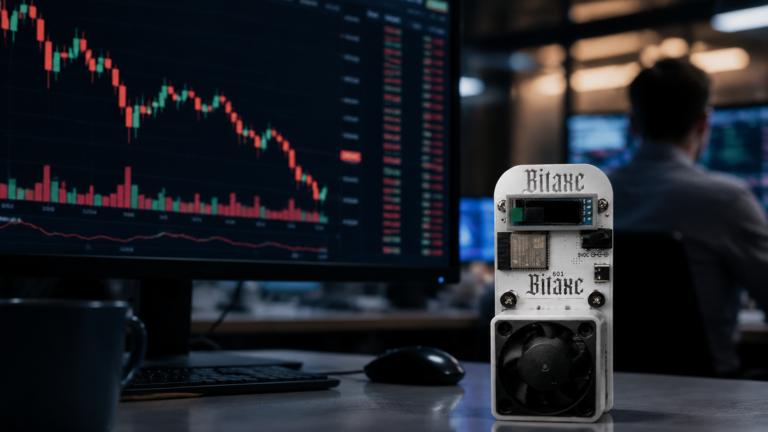
A home miner is not competing with an industrial mining farm on scale. A small Bitaxe-style miner is not a substitute for a megawatt facility, a large hosting agreement, or a public miner’s fleet.
It belongs in a different category.
Industrial miners are fighting for margin. They care about fleet efficiency, uptime, debt costs, power contracts, site expansion, treasury management, and production cost. Their question is straightforward: can this operation produce Bitcoin at a lower cost than the market price over time?
Home miners are usually asking a different question.
Can I run real Bitcoin hardware? Can I understand Proof of Work beyond a price chart? Can I participate in the network from my desk, my garage, or my home office?
That does not make home mining a guaranteed-income strategy. It is not. Solo mining is probabilistic by design. A small miner can run for a very long time without finding a block.
Pretending otherwise helps no one.
The value of low-power home mining is that it keeps the original Proof of Work experience accessible. A home miner can see hashrate, power draw, temperature, firmware settings, pool data, and network participation directly.
Bitcoin stops being only a ticker on a screen. It becomes a physical system: chips, watts, heat, noise, probability, and time.
That matters more as industrial mining becomes more capital intensive.
Efficiency Is Still the Part Miners Can Control
Miners cannot control the Bitcoin price. They cannot control the next difficulty adjustment. They cannot control block rewards, transaction fees, or the broader market’s appetite for risk.
They can control what hardware they run, how efficiently it runs, how stable it is, and whether it stays online.
That is why hashprice near $30 is more than a weak revenue number. It is a reminder of what survives in mining.
The biggest machines do not always win if they are paired with bad power economics. The cheapest machines do not always win if they are unstable or inefficient. The best setups are the ones that keep hashing when conditions are not friendly.
For industrial miners, that means power strategy, balance sheet discipline, uptime, and hardware efficiency.
For home miners, it means low power draw, stable operation, realistic expectations, and a clear understanding that solo mining is probability, not guaranteed payout.
Bitcoin mining has always been a test of patience. The machines do the same thing every second: hash, reject, hash again, and wait for the next block.
When hashprice is high, patience is easier.
When hashprice is low, the market finds out who built for the long run.
In a tight mining market, the machines that matter are not only the biggest ones.
They are the ones that can keep hashing.