
Bitcoin’s Mining Cost Problem Is Really a Cash-Flow Problem
Bitcoin can bounce on a chart in minutes. A miner’s power bill does not.
That is the part of this cycle the market keeps underestimating. When bitcoin trades below estimated production cost, the pressure does not stay inside the price chart. It moves into cash flow, machine uptime, treasury decisions, and the simple question every miner eventually has to answer:
Can you keep the bitcoin you mine, or do you have to sell it just to stay online?
A recent JPMorgan analysis, reported by CoinDesk, estimated the all-in cost of producing one bitcoin at roughly $78,000. At the time, bitcoin was trading well below that level. The same analysis said about one-fifth of miners were operating at a loss, while publicly traded mining companies sold more than 32,000 BTC in the first quarter to cover operating costs.
Those numbers matter. But they need context.
There is no single “bitcoin mining cost” that applies to everyone. A listed miner in Texas, a hydro-powered site in South America, a large Middle Eastern operation, and a home miner running a small ASIC on a desk do not have the same cost structure. Power prices, hardware efficiency, debt, uptime, cooling, labor, hosting contracts, and depreciation all change the math.
So the $78,000 figure should not be treated as a universal breakeven line.
It is better understood as a pressure gauge.
When bitcoin stays below a sector-wide cost estimate for months, it tells us stress is building across the mining business. Not evenly. Not everywhere. But enough to affect how miners behave.
Mining Cost Is Not a Price Floor
One of the easiest mistakes is to assume that production cost creates a hard floor under bitcoin.
The argument sounds neat: if miners cannot produce bitcoin profitably, they will shut down, supply will tighten, and price will recover.
Reality is messier.
Mining cost does not force the market to move higher. It forces miners to make decisions.
Some shut off machines. Some sell BTC. Some renegotiate power contracts. Some delay expansion. Some move equipment. Some try to offset mining weakness with AI or high-performance computing contracts. Others keep running through thin or negative margins because they have cheap power, long-term site commitments, or a view that conditions will improve.
That is why production cost is useful, but dangerous when oversimplified.
It does not tell us where bitcoin must trade tomorrow. It tells us how much pressure miners are under today.
Bitcoin does not know a miner’s debt schedule. It does not know whether a site is paying five cents or nine cents per kilowatt-hour. It only accepts valid proof of work.
Difficulty Can Drop. Bills Do Not.
Bitcoin’s difficulty adjustment is elegant. Every 2,016 blocks, the network adjusts how hard it is to mine a block, keeping block production close to its long-term target.
When hashrate leaves, difficulty eventually comes down. That gives the miners still online a larger expected share of rewards.
But it does not solve everything.
After the recent adjustment, Bitcoin difficulty has been sitting around 124.93T, down from roughly 138.96T before the drop. That helps. It reduces competition for miners that remain online.
Still, a lower difficulty does not lower a power bill. It does not erase interest payments. It does not reverse hardware depreciation. It does not turn an old, inefficient ASIC into a competitive machine.
Difficulty can reset network competition.
It cannot reset a miner’s balance sheet.
That is why a difficulty drop can happen while miners are still under pressure. In many cases, the drop is not the end of the stress. It is evidence that the stress has already pushed some hashrate offline.
Relief is not the same thing as recovery.
The Real Signal Is Miner Selling
The more important signal may not be the cost estimate itself. It may be the BTC selling.
Public miners reportedly sold more than 32,000 BTC in the first quarter. That does not automatically mean they are bearish on bitcoin. Often it means something much simpler: they need cash.
Electricity, hosting, payroll, maintenance, interest, and infrastructure are paid in fiat terms. When margins get tight, bitcoin on the balance sheet becomes working capital.
That changes how mining companies should be judged.
The market loves production numbers. How many BTC did a miner produce this month? How much hashrate did it deploy? How fast is the fleet growing?
Those numbers still matter. But in a tight-margin environment, they are not enough.
A miner can produce more BTC and still end the quarter in a weaker position if it has to sell most of that production to fund operations.
The better question is retained bitcoin.
After paying for power, hardware, debt, site costs, and expansion, how much BTC can the miner actually keep?
That is where the industry starts to separate. Low-cost, efficient operators with cleaner balance sheets may be able to preserve more of their production. Higher-cost operators may be stuck in a loop: mine bitcoin, sell bitcoin, pay bills, repeat.
Both may still be called “bitcoin miners.”
But they are not in the same position.
Hashprice Shows the Pain First
For miners, bitcoin price is only one part of the equation. Hashprice is usually the cleaner signal.
Hashprice tells miners how much revenue each unit of hashrate can expect before their own costs are deducted. When hashprice falls, every miner feels it. But not equally.
An efficient fleet with cheap power may still survive. Older machines at higher electricity rates can fall below breakeven quickly.
That is why mining stress usually shows up first in older hardware, high-cost power markets, and operators with weaker balance sheets. CoinShares has estimated that roughly 15% to 20% of the global mining fleet may be unprofitable under recent hashprice conditions, especially older or less efficient machines running at higher electricity costs.
That is a sharper point than simply saying “miners are struggling.”
Mining is brutally comparative. The network does not need every miner to be profitable. It only needs enough profitable hashrate to keep blocks coming.
The weakest machines take the first hit.
Efficiency Matters More Than Size
When margins tighten, scale alone does not save a miner.
A large fleet of inefficient machines can look impressive on paper and still be fragile. A smaller operator with better efficiency and lower power costs may be in a stronger position.
This is why joules per terahash matters. So does uptime. So does the actual cost of power.
A miner with 10 EH/s of weak economics may be less durable than a smaller fleet with better machines and a cleaner cost base. The market often talks about size. Mining rewards efficiency.
That is also why older hardware tends to leave first. It needs more electricity to produce the same hashrate. If bitcoin price is weak and hashprice stays low, a difficulty drop may not be enough to bring those machines back.
Some rigs need more than lower difficulty. They need cheaper power, better tuning, lower hosting costs, or a much stronger bitcoin price.
Home Miners Should Not Copy Industrial Math
This is where home miners need to be careful.
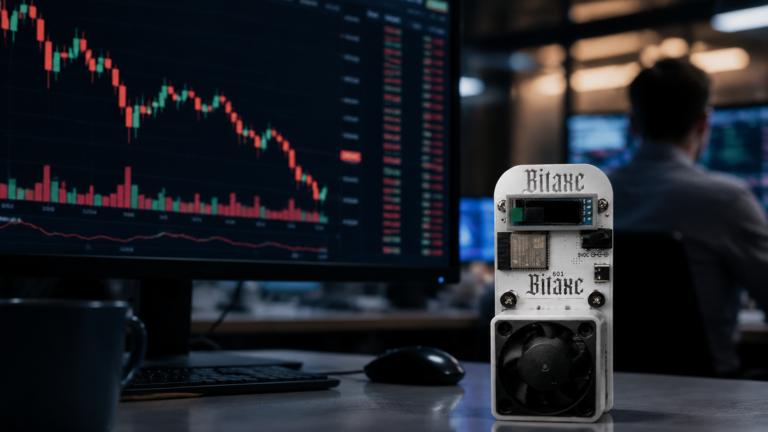
Industrial mining cost models do not translate neatly to a Bitaxe, a small ASIC, or a solo mining setup at home.
A public mining company may include power contracts, site leases, staff, insurance, interest, depreciation, infrastructure buildout, and corporate overhead in its cost base. A home miner is often making a different decision.
Electricity still matters. Efficiency still matters. Stability still matters.
But the purpose may be different.
For industrial miners, the goal is usually predictable production, scale, and return on capital. For many home miners, the value may also include learning, running real proof-of-work hardware, participating in the Bitcoin network, and experimenting with solo mining.
Solo mining must be understood as probabilistic. It does not provide stable income. It does not guarantee a block. A small miner can participate honestly in the network, but it should never be sold as a reliable yield machine.
That is the real lesson from this mining squeeze.
Hashrate alone is not the full story. Power efficiency, thermal design, uptime, and realistic expectations matter just as much.
The AI Pivot Is Not a Free Escape
Some large miners are trying to reduce their dependence on bitcoin mining by shifting part of their infrastructure toward AI and high-performance computing.
The logic is understandable. If a company controls power, land, cooling, and data center capacity, it may be able to sell compute to customers outside Bitcoin.
But the AI pivot does not magically fix mining economics.
It requires capital. It requires customers. It takes time. It may also make mining cost harder to compare across companies, because hybrid operators no longer look like pure bitcoin miners.
For investors, that means the old metrics are not enough.
BTC produced still matters. Hashrate still matters. Efficiency still matters. But debt, power strategy, capital expenditure, AI contract quality, and BTC retention matter too.
A miner that funds an AI buildout by selling bitcoin may be building a new business. It may also be adding another capital-heavy cycle on top of an already pressured mining operation.
The details matter.
What to Watch Next
The next signal is not just whether bitcoin trades above or below one estimated cost number.
Watch hashprice. Watch the next difficulty adjustment. Watch whether older machines keep coming offline. Watch whether public miners continue selling large amounts of BTC. Watch whether AI and HPC revenue actually reduces selling pressure, or simply creates another reason to spend capital.
Most of all, watch retained bitcoin.
A miner that produces a lot of BTC but sells most of it is not in the same position as a miner that can pay its bills and still keep BTC on the balance sheet.
That is the real dividing line in this cycle.
Bitcoin mining pressure does not disappear because difficulty falls once. It eases only when revenue, efficiency, power cost, and balance-sheet strength line up again.
Until then, some miners are turning proof of work into bitcoin accumulation.
Others are turning it into just enough cash flow to stay online.
FAQ 1
Is Bitcoin mining cost a price floor for bitcoin?
No. Bitcoin mining cost is better understood as a pressure gauge for miners, not a guaranteed price floor. When bitcoin trades below estimated production cost, miners may shut down machines, sell BTC, renegotiate power contracts, or reduce expansion. The market does not have to move higher simply because some miners are under pressure.
FAQ 2
Does lower Bitcoin difficulty make mining profitable again?
Not automatically. A lower difficulty can reduce competition for miners that remain online, but it does not lower electricity bills, debt payments, hardware depreciation, or hosting costs. Profitability still depends on bitcoin price, hashprice, power cost, machine efficiency, and uptime.
FAQ 3
Why are Bitcoin miners selling BTC?
Miners often sell BTC to cover operating costs such as electricity, hosting, payroll, maintenance, interest, and infrastructure spending. Selling BTC does not always mean miners are bearish on bitcoin. In many cases, it reflects cash-flow pressure.
FAQ 4
What is hashprice in Bitcoin mining?
Hashprice measures how much revenue a unit of mining hashrate can expect before costs are deducted. It is one of the clearest indicators of mining profitability because it connects bitcoin price, transaction fees, network hashrate, and difficulty into one mining-specific revenue metric.
FAQ 5
Should home miners use industrial mining cost models?
Not directly. Industrial miners may include power contracts, site costs, staff, debt, depreciation, and corporate overhead in their cost models. Home miners usually have a different setup, different goals, and different constraints. For home mining and solo mining, electricity cost, efficiency, uptime, noise, learning value, and realistic expectations matter more than copying public miner cost models.