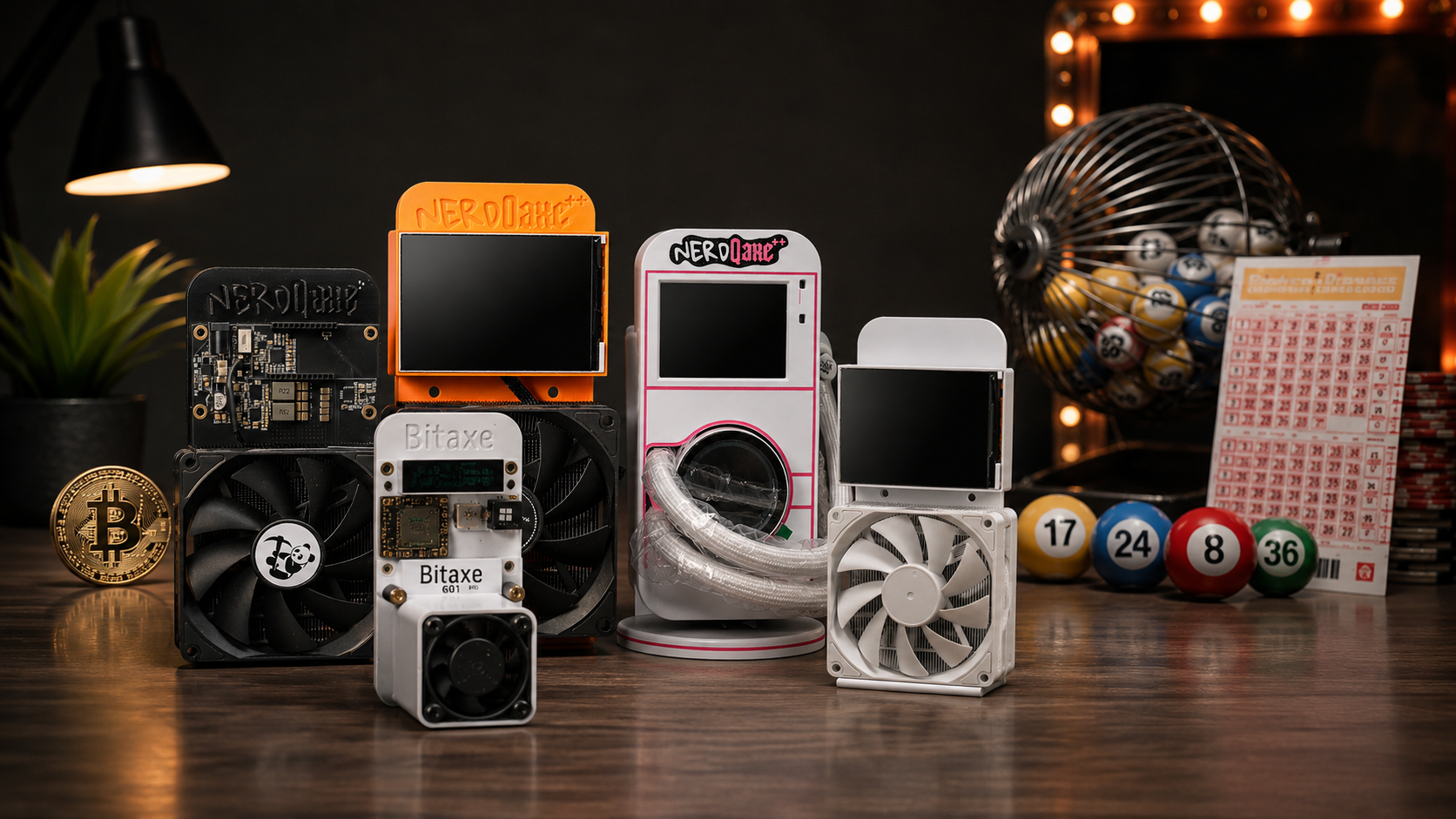
Bitcoin Lottery Mining Looks Absurd Until You Compare It to Powerball
Bitcoin home mining sounds irrational when it is explained badly. You plug in a small machine, point it at the network, and hope that your little slice of hashrate somehow finds a Bitcoin block before the rest of the planet does. Put that way, home Bitcoin mining looks like a strange hobby for people who enjoy impossible odds.
But then compare it with Powerball.
According to the original report, the math behind lottery-style Bitcoin mining can look less ridiculous once you stop thinking about one single attempt and start thinking about repeated chances over time. That does not make solo mining easy. It does not make a small miner a money machine. It just exposes how strange the normal lottery is when people call that “reasonable entertainment” but call Bitcoin mining hardware irrational.
The more useful question is not, “Will this small miner hit a block?” Most likely, no.
The better question is, “What do you still get if it does not?”
The Powerball comparison is fun, but easy to misuse
The Powerball comparison works because both things sit in the same psychological category: tiny odds, big reward, a little bit of daydreaming.
That is where the comparison should stop.
A Powerball ticket is a dead object after the drawing. It teaches you nothing. It connects you to nothing. It does not make you understand probability better unless you force yourself to look at the numbers. It does not help you understand energy, hardware, networks, wallets, or custody. It is just a printed hope receipt.
A Bitcoin miner is different, even when the odds are ugly.
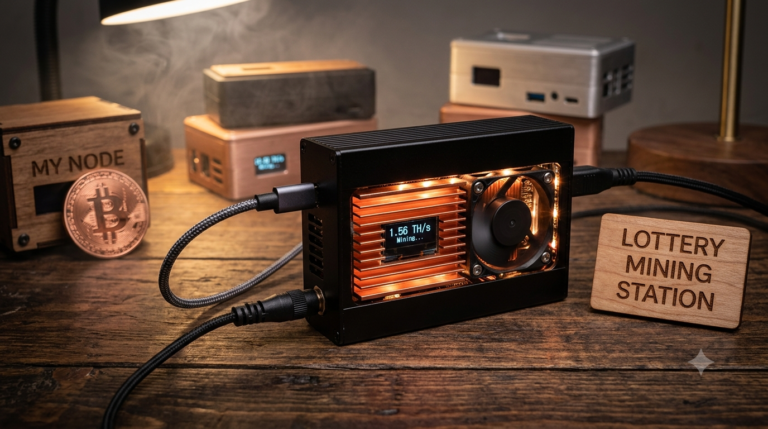
A small Bitaxe miner running in solo mining mode is still doing real SHA-256 work. It is still communicating with mining infrastructure. It still forces the owner to learn what a payout address is, what a pool URL is, why latency matters, why cooling matters, why firmware matters, and why hashrate is not magic.
That is already more than a lottery ticket gives you.
This is where many critics get the discussion wrong. They attack lottery mining as if supporters are claiming that a tiny home miner is a rational replacement for industrial mining. That is not the point. A desktop Bitcoin miner is not competing with a warehouse full of ASICs in any serious economic sense. It is competing with passive fandom.
A Bitaxe miner does not buy a jackpot. It buys participation
The worst way to sell lottery mining is to make it sound like a shortcut to a block reward.
That framing attracts the wrong people and disappoints them quickly. Someone who plugs in a small miner expecting predictable income is going to hate the experience. The device will sit there hashing, the dashboard will keep updating, and most likely nothing dramatic will happen.
That is normal.
The healthier frame is participation. A Bitaxe miner gives a normal person a physical way to touch Bitcoin mining. Not read about it. Not argue about it on X. Not repeat talking points about Proof of Work. Actually run hardware.
For people who spend years hearing that Bitcoin mining is only for giant companies, that matters. The modern mining industry is professional, competitive, and capital-heavy. Nobody serious should pretend otherwise. But if the only people who understand mining are industrial operators, exchanges, analysts, and ASIC brokers, then a huge part of the Bitcoin user base becomes dependent on secondhand explanations.
Bitcoin home mining pushes back against that. Not by replacing large miners, but by making mining understandable again.
That is why small miners have become interesting. The hardware is not just about the block reward. It is about making the process visible.
The real math is repeated shots, not one lucky ticket
Powerball feels easier to understand because the ticket has one clean number attached to it. Buy a ticket, wait for a drawing, lose, throw it away.
Mining is messier.
A miner is not buying one drawing. It is participating continuously. Bitcoin produces blocks roughly around the clock, and every block is a new race. The probability for a small miner remains tiny, but the structure of the game is different. The machine does not disappear after one attempt.
That distinction is why the original report’s argument caught attention. A single low-power miner has almost no chance against the global network on any individual block. No honest person should soften that. But over many blocks, over many days, the comparison with a weekly lottery ticket starts to feel less ridiculous.
Still, there is a trap here.
People love to hear “better odds than Powerball” and stop thinking. Better odds do not mean good odds. They do not mean likely. They do not mean the outcome is close. A one-in-a-very-large-number chance can be better than another one-in-a-much-larger-number chance and still be brutal.
That is the line a serious Bitcoin mining article should not cross. The Powerball comparison is useful as a mental model. It is not a sales pitch.
Home Bitcoin mining changes the psychology of losing
With a lottery ticket, losing is pure loss. You bought a chance, the chance expired, and the paper became trash.
With a home miner, the “loss” is different. You may not find a block. In fact, you should assume you probably will not. But the machine can still leave you with something: knowledge, operational experience, a better sense of mining economics, and a more grounded view of Bitcoin itself.
That sounds small until you spend time in crypto communities.
A lot of people talk about mining without understanding what a miner actually does. They argue about energy without knowing what a watt-hour feels like on a device. They debate custody without having configured a wallet address for a real payout. They talk about network security without ever watching hashrate fluctuate on their own dashboard.
A small Bitcoin miner changes that.
This is also where brands in the home mining space need to be careful. A company like SoloBitaxe can be part of this trend, but the honest message is not “buy this and win.” The better message is simpler: this is a way to participate, learn, and run real mining hardware at a human scale.
That message will age better because it is closer to the truth.
Small miners make Bitcoin less abstract
Bitcoin has a problem that does not get discussed enough: the more successful it becomes, the more abstract it can feel to normal users.
People hold it on exchanges. They read price headlines. They watch charts. They follow ETF flows. They repost macro opinions. But fewer people touch the machinery underneath.
Mining fixes that in a way that is hard to fake.
When a small miner is running on a desk, Bitcoin stops being only a ticker symbol. It becomes a process. Heat, sound, power, chips, firmware, network connection, wallet address, pool configuration. Suddenly Proof of Work is not a phrase. It is a machine doing the work.
That does not mean everyone needs a miner. Most people will not want one. Some people should not bother. Electricity costs, noise tolerance, heat, technical patience, and realistic expectations all matter.
But for the right person, a small miner can make Bitcoin feel less like a financial product and more like an open network that normal people can still touch.
That is a big difference.
Treat the odds honestly, or don’t do it
There is nothing wrong with calling lottery mining a lottery-style activity. That is the honest label. The problem starts when people remove the word “lottery” and pretend the outcome is more predictable than it is.
A small home miner may never find a Bitcoin block. That has to be said plainly.
But that does not make it pointless.
If the only goal is a payout, the math will probably feel cruel. If the goal is to learn mining, run real hardware, understand solo mining, and take a tiny shot at a real block while doing it, the experience makes more sense.
Powerball sells a dream that disappears after the draw.
Bitcoin mining, even at home, leaves the machine running and the lesson in front of you.
The odds are still harsh, but at least you are not just holding a ticket.