
Looking Back from 2031: Was Bitcoin Really Expensive in 2026?
When people first start taking Bitcoin seriously, the question they usually ask is not whether Bitcoin has value.
The question is:
“Am I too late?”
When BTC trades at tens of thousands of dollars, people say it is too expensive. When it breaks new highs, they wait for a pullback. When the pullback finally comes, they start wondering whether the cycle is over.
That is the strange thing about Bitcoin. It is constantly doubted on the way up, and then years later, many people look back and realize that the “expensive” price they once hesitated at may have been an opportunity.
A recent Bitcoin forecast looking toward 2031 offers an interesting long-term perspective. The core idea is simple: the next five years may not be driven only by short-term market sentiment. They may be shaped by the 2028 halving, continued spot ETF demand, institutional adoption, and Bitcoin’s growing role as a global store-of-value asset.
If we look at today from the perspective of 2031, many of the arguments people are having right now may look very short-sighted.
The forecast suggests that Bitcoin could trade between $115,000 and $150,000 in 2026. The key level is the $95,000 to $100,000 resistance zone. If Bitcoin breaks through that range and holds above it, the market could enter another phase of price discovery.
That is something we have seen before. Bitcoin always looks uncertain before the breakout, obvious after the breakout, and terrifying during the pullback. But the long-term trend has never been about one candle, one headline, or one Federal Reserve meeting. It has always been about whether the network keeps growing, whether it remains secure, and whether more people continue to hold, verify, build, and participate.
In 2027, the forecast expects Bitcoin to enter a consolidation phase, possibly trading between $90,000 and $130,000. That would not be unusual. Every major Bitcoin cycle has had strong rallies followed by painful corrections.
The difference is that future corrections may not look exactly like the old ones. Spot ETFs, corporate treasuries, and long-term institutional buyers may absorb some of the selling pressure. Bitcoin is no longer just a retail-driven speculative asset. It is slowly becoming part of the global financial conversation.
That shift matters.
For years, many people saw Bitcoin only as something to trade. Today, more investors are beginning to see it as something to hold. The price will still move violently, but the underlying narrative is becoming stronger.
Then comes 2028, which may be one of the most important years in this cycle.
Bitcoin’s next halving is expected to reduce the block reward from 3.125 BTC to 1.5625 BTC. The forecast suggests that BTC could reach $200,000 to $300,000 in 2028.
The halving is not magic. It is supply and demand.
Every day, fewer new bitcoin enter the market. If demand from ETFs, companies, pensions, sovereign funds, and long-term holders continues to grow, the pressure on Bitcoin’s fixed supply becomes harder to ignore.
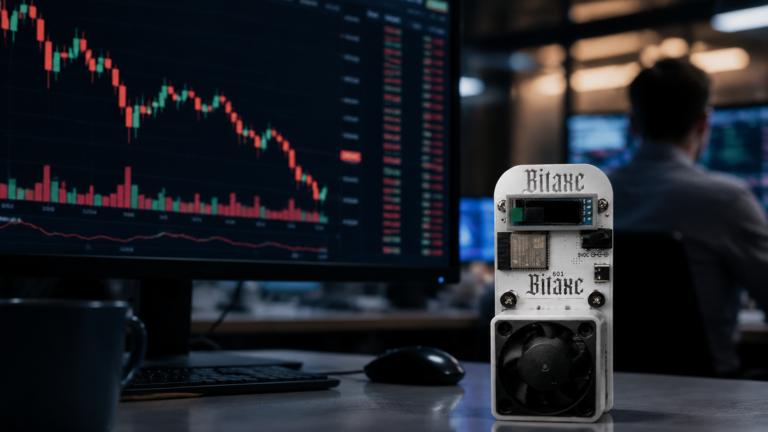
This is also why SoloBitaxe pays attention to home mining. Too many people only focus on Bitcoin’s price and forget what Bitcoin actually is.
Bitcoin is not just an asset on a chart. It is an open, permissionless monetary network. You can hold it. You can run a node. You can learn the rules for yourself. You can even participate in mining with small, open-source hardware.
That matters.
Owning Bitcoin is one level of understanding. Participating in the network is another.
By 2029, the forecast sees Bitcoin potentially moving into the $300,000 to $500,000 range. Historically, the period 12 to 18 months after a halving has often been when market excitement returns. Institutions may accumulate first, and then retail attention usually follows once the price becomes impossible to ignore.
If global pensions, insurance companies, corporate treasuries, or sovereign funds allocate even a small percentage to Bitcoin, the demand impact could be enormous. Bitcoin’s supply cannot be expanded to meet new demand. That is the point.
Fiat supply can change. Equity issuance can change. Bitcoin’s rules do not change just because demand increases.
That fixed supply is what makes Bitcoin different.
By 2030, the forecast becomes even more aggressive, suggesting a possible range of $400,000 to $700,000. The logic comes from Bitcoin’s comparison with gold. If Bitcoin captures even a meaningful fraction of global store-of-value demand, then its valuation framework changes.
At that point, Bitcoin is no longer just being valued as a crypto asset. It starts being valued as part of the global store-of-value market.
That is why many long-term Bitcoin believers do not measure it only by short-term price action. In the short run, Bitcoin will be affected by liquidity, interest rates, regulation, leverage, and sentiment. But in the long run, it is competing for something much bigger: trust.
Bitcoin is competing with gold, fiat currencies, central banks, and traditional stores of value. It offers a monetary network that does not depend on a government, a company, or a central decision-maker.
By 2031, the forecast expects Bitcoin to settle somewhere between $200,000 and $500,000. That does not mean the price only goes up forever. If Bitcoin peaks in 2029 or 2030, then 2031 may become a high-level consolidation year. Even a 40% or 50% correction from the top could still leave BTC far above today’s levels.
That is one of the easiest things to misunderstand about Bitcoin.
People see a correction and think the story is over. But if you zoom out, many of those crashes were simply violent pauses before the next higher range.
Short term, Bitcoin often looks like chaos. Long term, it has looked like a network monetizing in public.
The real question is not whether Bitcoin will be volatile. It will be.
The real question is this:
When you look back from 2031, will you realize that you spent too much time worrying about short-term price moves and not enough time understanding the network itself?
Bitcoin has no CEO. No board of directors. No central bank meetings. No press conferences. No committee deciding whether the rules should change next month.
It just keeps running.
Roughly every 10 minutes, another block.
That is also the deeper meaning of home mining. It is not only about mining a small amount of bitcoin. It is about participation. For a long time, people assumed Bitcoin mining belonged only to industrial farms, large institutions, and regions with cheap electricity. But small open-source miners are bringing back a different idea: ordinary people can still learn, experiment, and connect directly with the Bitcoin network.
Even at a small scale, that idea is powerful.
Bitcoin should not belong only to exchanges, ETFs, institutions, or mining giants. It should also belong to individuals who want to understand and participate.
If Bitcoin is trading at hundreds of thousands of dollars in 2031, many ordinary actions from today may look different in hindsight.
Buying a little bitcoin.
Running a node.
Learning self-custody.
Starting a small miner at home.
Understanding what “one block every 10 minutes” really means.
None of these things may look dramatic today. But in the future, they may be seen as early signals of conviction.
People will always ask whether they are too late.
Maybe the better question is:
If Bitcoin keeps running for the next five years, if the 2028 halving happens as expected, if institutional demand continues to grow, and if more people begin to treat BTC as digital gold, will today’s “too late” look like tomorrow’s “still early”?
From 2026 to 2031, Bitcoin may go through a breakout, a consolidation, a halving, a demand shock, a cycle peak, and another high-level reset. Nobody can guarantee any price target. Every forecast can be wrong.
But one thing is clear:
Bitcoin’s long-term story has never been only about price.
Price gets attention.
The network is what matters.
And the network is still producing blocks.
Every 10 minutes.
No permission required.
No central authority needed.
Just Bitcoin.