

Bitcoin ETFs Made Buying Easy. Holding Is Still the Hard Part.
Bitcoin ETFs were supposed to make Bitcoin easier.
In one sense, they did.
They made it easier to buy, easier to hold in a brokerage account, and easier for traditional investors to get exposure without touching an exchange, setting up a wallet, or writing down a seed phrase.
That was the breakthrough.
But the past few weeks have shown the part Wall Street could not package away.
Bitcoin may be easier to access now. It is not easier to sit through.
According to The Block, U.S. spot Bitcoin ETFs recorded roughly $1.79 billion in net outflows in the week ending June 26, making it the second-largest weekly outflow since the products launched in January 2024. The same report cited Bespoke Investment Group data, reported by Bloomberg, showing that the average investor in BlackRock’s IBIT was down about 40%.
That is not just a fund-flow story.
It is a reminder that access and conviction are two very different things.
The ETF Door Opens Both Ways
The biggest promise of spot Bitcoin ETFs was simple: bring Bitcoin into the traditional financial system.
That part worked.
Investors could buy Bitcoin exposure through the same brokerage accounts they already used for stocks and index funds. Advisors had a cleaner product to discuss with clients. Institutions had a familiar wrapper. The technical friction was removed.
No exchange account.
No self-custody.
No private keys.
No cold storage learning curve.
For many people, that was exactly what they were waiting for.
But the same structure that makes an ETF easy to buy also makes it easy to sell.
There is no friction on the way out. No withdrawal process. No moment where the investor has to think about what Bitcoin actually is beyond the ticker. When fear hits, the sell button is sitting right there next to every other liquid asset in the account.
That is not a flaw in the ETF.
That is the ETF doing what it was built to do.
Liquidity cuts both ways.
Exposure Is Not Conviction
IBIT became one of the defining products of the Bitcoin ETF era.
BlackRock describes the fund as a way to reflect the performance of the price of Bitcoin while simplifying the operational and custody challenges of holding Bitcoin directly. For traditional investors, that is a useful product.
But price exposure is not the same as Bitcoin conviction.
Someone can buy IBIT without knowing how Bitcoin mining works. They can own Bitcoin exposure without understanding what a block is. They can participate in the upside without ever thinking about Proof of Work, difficulty adjustments, hashrate, energy, miners, or why the network keeps producing blocks when the market looks ugly.
In a bull market, nobody cares how much they really understand Bitcoin.
In a drawdown, that gap gets expensive.
When the chart is green, access feels like innovation. When the chart turns red, access can become a fast exit ramp.
That is the part many ETF headlines miss.
The question is not whether Bitcoin ETFs are good or bad. The question is what they actually solve.
They solve distribution.
They do not automatically build conviction.
Wall Street Changed the Wrapper. It Did Not Change Bitcoin.
Bitcoin did not become less volatile because it entered a brokerage account.
The wrapper changed.
The asset did not.
Bitcoin is still a global, open, 24/7 monetary network. It still trades through liquidity cycles, leverage cycles, macro pressure, panic, euphoria, and long stretches where the price action can make even experienced holders uncomfortable.
An ETF can make Bitcoin easier to buy.
It cannot make Bitcoin behave like a Treasury fund.
That distinction matters because many first-time ETF buyers came into Bitcoin through an interface that felt familiar. The account looked familiar. The product looked familiar. The trade looked simple.
But the underlying asset still carried Bitcoin’s full emotional weight.
That weight includes sharp drawdowns. It includes violent rallies and sudden reversals. It includes months where price action looks disconnected from long-term fundamentals. It includes the uncomfortable reality that Bitcoin often teaches patience through pain, not through a clean upward chart.
The ETF changed the path into Bitcoin.
It did not change what it takes to stay there.
The Part a Ticker Cannot Show You
Most Bitcoin ETF coverage focuses on flows.
How much came in.
How much went out.
Which issuer gained share.
Which fund lost assets.
Whether institutions are buying, selling, or stepping back.
Those numbers matter. But they are only one layer of the story.
Bitcoin is not only a financial product. It is a working network.
Every block still has to be found. Every transaction still has to be confirmed. Miners still compete using real hardware, real electricity, real chips, real heat, real firmware, real cooling, and real operating discipline.
That physical layer disappears when Bitcoin is reduced to an ETF ticker.
It is also the layer that gives Bitcoin much of its meaning.
Proof of Work is not a marketing phrase. It is the process that keeps the network moving. Hashrate is not just a number on a dashboard. It represents machines around the world doing the same thing over and over again: searching for the next valid block.
That is the part a brokerage account does not show you.
An ETF shows you the price.
A miner shows you the machine behind the price.
Where Home Mining Fits
Home mining is not a replacement for an ETF.
It is not a guaranteed income strategy. It is not a shortcut around volatility. It does not remove risk, and solo mining is probabilistic by nature.
But it does something an ETF cannot do.
It makes Bitcoin physical.
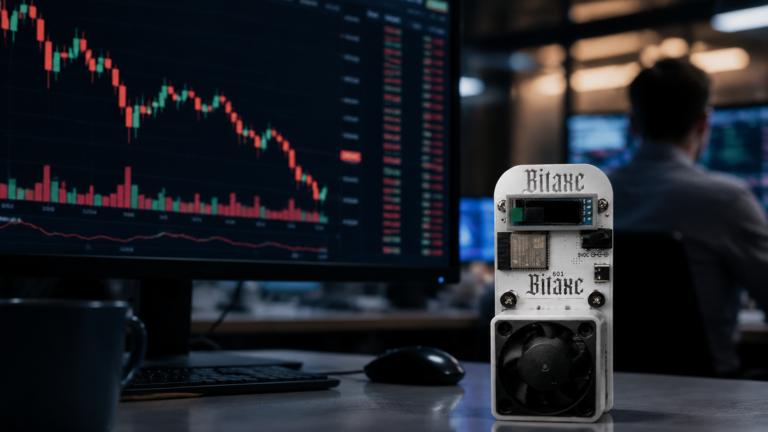
A small ASIC miner on a desk is not trying to compete with industrial mining farms on scale. That is not the point. Its value is different. It lets someone see hashrate in real time. It shows power draw. It shows heat. It shows uptime. It turns mining difficulty and Proof of Work from abstract terms into something you can actually watch.
That experience changes how some people understand Bitcoin.
They stop seeing it only as a chart.
They begin to see it as infrastructure.
For SoloBitaxe, that is where home mining matters. A home miner is not about pretending to be a public mining company. It is about giving individuals a low-power, hands-on way to engage with Bitcoin’s operating layer from home.
ETF exposure is financial.
Home mining is technical, educational, and participatory.
Both can exist.
They simply answer different questions.
An ETF answers: how do I get exposure to Bitcoin’s price?
A miner answers: how does this network actually run?
Buying Was the Easy Part
The Bitcoin ETF era proved that distribution can move faster than understanding.
Wall Street can package Bitcoin. Brokers can list it. Investors can buy it in seconds. Funds can attract billions of dollars. Flows can reverse almost as quickly.
But none of that makes Bitcoin easy to hold.
Holding Bitcoin still requires context. It requires knowing what kind of asset it is. It requires understanding that volatility was not created by crypto exchanges, and it was not removed by ETF approval.
It is part of Bitcoin’s market reality.
For some investors, Bitcoin will remain just another trade.
For others, real conviction begins only after they move past the ticker and start learning the network underneath it.
That is where the real education begins.
Bitcoin ETFs opened the door.
They did not do the work for anyone who walked through it.
This article is for educational purposes only and is not investment advice. Bitcoin ETFs, direct Bitcoin ownership, and home mining all carry different risks. Solo mining is probabilistic and does not provide predictable income.