

Bitcoin’s Next Drop May Be Smaller Than Bears Expect
According to the original report, Bitcoin may still be tracking a historical cycle pattern, with a possible bear market bottom arriving around September or October 2026. That is the fact being discussed. The more interesting question is not whether Bitcoin can fall again. Of course it can. The better question is whether the next major drawdown will look anything like the brutal cycle collapses people still use as their mental model.
My view is simple: the bears may be directionally right on timing, but wrong on depth.
A move toward a much lower Bitcoin price is still possible. A bottom around the $38,000 area is a reasonable scenario to discuss, not because charts have magical powers, but because Bitcoin has always punished people who assume the current structure makes downside impossible. But if that kind of level becomes the bear case, not the base case for total collapse, it would say something important. Bitcoin may still be cyclical, but the market around Bitcoin is no longer the same market that existed in earlier cycles.
The bearish chart is not useless
Crypto people love to mock cycle models when prices are going up and then rediscover them when prices start falling. That is not serious analysis. Historical Bitcoin cycles are not sacred, but they are not meaningless either.
Bitcoin has repeatedly moved through periods of aggressive speculation, forced deleveraging, boredom, and then renewed accumulation. That pattern is not just a chart shape. It reflects human behavior. People chase strength, overpay, get liquidated, lose interest, and then slowly return when the noise fades.
So yes, the idea of a deeper pullback into late 2026 deserves attention. A market that has moved too far too fast can spend months correcting. ETF flows do not eliminate leverage. Institutional ownership does not remove fear. A larger market can still panic.
But the mistake is assuming that because the rhythm may repeat, the magnitude must repeat too. Bitcoin is not trading in the same environment it did during earlier bear markets. The buyer base is broader. The product access is cleaner. The public conversation is less confused than it used to be. That does not make Bitcoin safe. It makes the old crash template less reliable.
A shallower bear market would make sense
A bottom around $38,000 would still feel painful to many market participants. It would generate the usual headlines, the usual “Bitcoin is dead again” takes, and the usual social media victory laps from people who were quiet during the run-up.
But compared with previous cycle drawdowns, that kind of bottom would also be a sign of structural strength.
That is the part many people miss. If Bitcoin goes through a full bear phase and still holds at levels that earlier cycles would have considered impossible, the market is not just repeating history. It is repricing the meaning of a bear market.
The strongest argument for a smaller drawdown is not blind optimism. It is market acceptance. Bitcoin is no longer just a retail-led speculative asset bouncing between crypto exchanges and Twitter narratives. It now sits inside a much larger financial conversation. Spot ETF demand has changed how many investors access Bitcoin. More allocators can get exposure without dealing with wallets, exchanges, custody headaches, or operational friction.
That does not mean ETF buyers will never sell. They will. But it does mean the market has more layers than it used to. Some holders are short-term traders. Some are macro allocators. Some are long-term believers. Some are miners. Some are simply using Bitcoin as a hedge against a financial system they do not fully trust. That mix can still produce volatility, but it can also reduce the odds of total air pockets.
ETF demand changes the floor, not the risk
The lazy version of the ETF argument says, “Institutions are here, so Bitcoin cannot crash.” That is wrong.
The better version says ETF demand may change where long-term buyers start showing up. In earlier cycles, Bitcoin often depended heavily on crypto-native liquidity. When that liquidity dried up, the market could fall violently because there were fewer natural buyers outside the same ecosystem.
Now the market has a different kind of access point. ETF demand gives Bitcoin a bridge into brokerage accounts, retirement portfolios, advisory platforms, and more traditional allocation models. That creates a broader potential bid. It does not guarantee a bottom, but it may make extreme downside harder to sustain.
This is also where the 2026 bear case becomes more nuanced. A cycle-based model may still point to late 2026 as the danger zone. But if ETF demand remains meaningful, the decline could be more compressed than past cycles. The market could still bleed, but not necessarily break.
That would frustrate both sides. Bulls want a straight line up. Bears want a clean collapse. Bitcoin usually gives neither group exactly what they want.
Bitcoin mining tells a different story than price alone
Price gets most of the attention, but Bitcoin mining often gives a cleaner read on conviction. When people are only trading the chart, they think in quarters or months. Miners think in hardware, power, uptime, heat, efficiency, and payback periods. That is a different relationship with the network.
A bear market affects mining economics directly. Lower Bitcoin prices can pressure margins, especially for inefficient operators. Large industrial miners have to manage debt, hosting costs, energy contracts, and fleet upgrades. Weak price action can expose bad planning quickly.
But there is another side of Bitcoin mining that is easy to ignore: small-scale participation. Bitcoin home mining has become more visible because not every miner is trying to run a warehouse. Some people want to learn how mining works. Some want to run a compact Bitcoin miner at home. Some are interested in solo mining because they like the lottery-like nature of finding a block, even if the odds are extremely low.
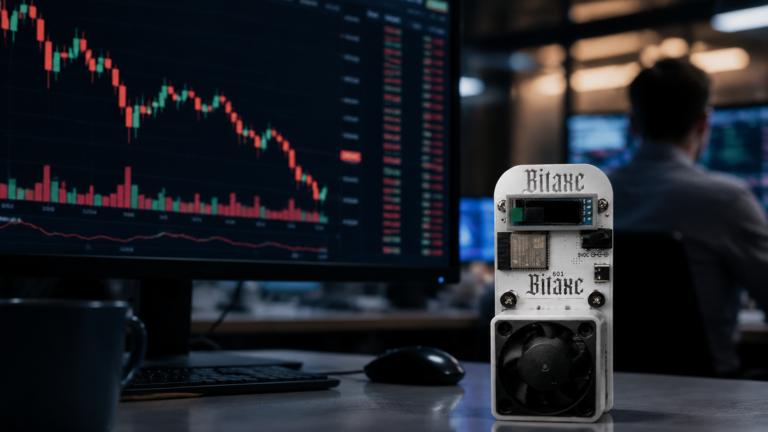
This is where devices like a Bitaxe miner fit into the broader discussion. A small miner will not compete with an industrial farm on output, and it should not be marketed as if it will. Its real role is different. It gives regular people a physical connection to Bitcoin mining hardware and the network itself.
That matters during bear markets. When price tourists leave, the people who remain tend to be builders, miners, node runners, developers, and stubborn learners. Home Bitcoin mining is not about pretending everyone will get rich from a desk-sized machine. It is about keeping Bitcoin understandable at the individual level.
The market is maturing, but not becoming boring
There is a strange assumption that if Bitcoin becomes more accepted, it must become less volatile in a smooth and predictable way. That is probably too neat.
Bitcoin can mature and still trade violently. It can attract ETF flows and still disappoint late buyers. It can become more widely understood and still suffer ugly corrections. Maturity does not remove risk. It changes the kind of risk.
The old Bitcoin market was fragile because it was smaller, more reflexive, and more dependent on crypto-native liquidity. The newer Bitcoin market may be stronger, but also more connected to macro expectations, ETF flows, regulatory narratives, and institutional positioning. That is not automatically better or worse. It is just different.
So if Bitcoin does move into another major bear phase, the key question is not whether people can draw a line on a chart and find a past cycle that looks similar. The key question is how much real demand appears when fear returns.
If buyers show up around levels that would have been considered absurdly high in previous bear markets, that is a signal. It means the market’s pain threshold has moved. It means Bitcoin’s downside may still be violent, but not necessarily as deep as before.
A $38,000 bottom would not be failure
A potential bottom near $38,000 would be described by many headlines as a crash. In percentage terms, depending on where Bitcoin falls from, that may be fair. But in historical context, it would also suggest that Bitcoin’s bear markets are changing.
That is the uncomfortable middle ground. Bitcoin can be overextended and still structurally stronger than before. It can fall hard and still prove that adoption has improved. It can punish leverage without destroying the long-term base of holders, miners, and users.
For people watching Bitcoin only as a price chart, that may sound contradictory. For anyone who has watched this market through multiple cycles, it is not. Bitcoin has always looked weakest right when the most committed participants are quietly doing the most work.
That includes people building wallets, running nodes, improving mining firmware, testing Bitcoin mining hardware, and experimenting with small-scale solo mining setups at home. None of that prevents a bear market. But it does help explain why each bear market may be absorbing less damage than the last one.
The next Bitcoin drawdown may still hurt. It may even arrive close to the timing suggested by historical cycle analysis. But the real story is not just whether Bitcoin falls. It is whether the floor keeps moving higher while most people are busy arguing about the crash.
If that is what happens, the bears will get their drop, but not the collapse they wanted.