
Bitcoin’s 10% Drop Is Not the Mining Story
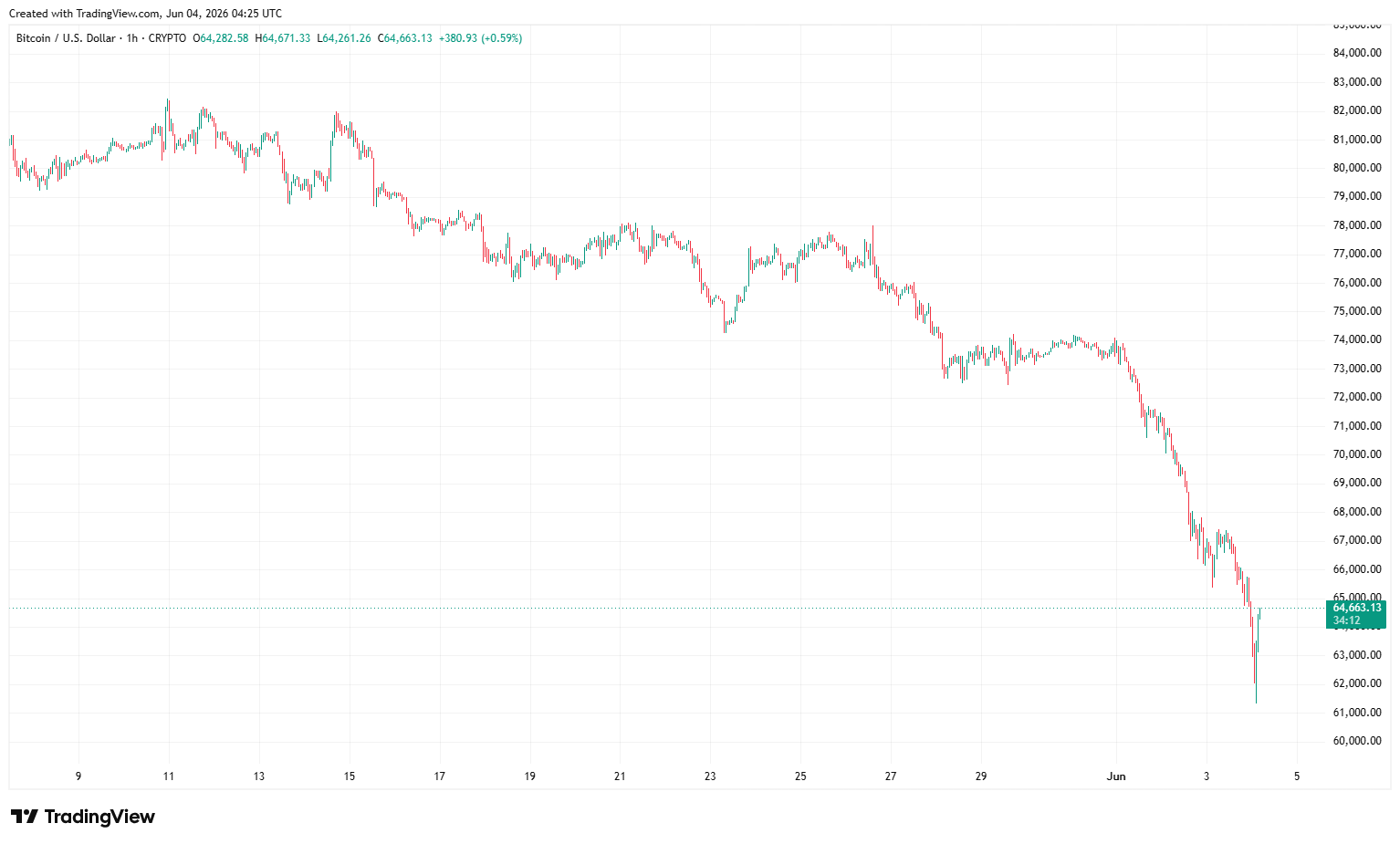
According to the original report, BTC dropped more than 10% from its recent high and moved into a range where traders are watching $62,000, $65,000, and the risk of a deeper breakdown. The report focuses on the usual short-term signals: support, resistance, a bearish trend line, hourly RSI, hourly MACD, and whether Bitcoin can reclaim the mid-$60,000 area.
That kind of BTC price analysis has its place. Traders need levels. Leverage needs levels. Risk managers need levels.
But a chart is not the whole Bitcoin story.
The market can spend all day arguing over whether Bitcoin price support holds near $62,000 or whether BTC gets rejected around $65,000. Meanwhile, the network keeps doing what it was designed to do: produce blocks, settle transactions, and make real-world hardware compete for the next hash.
That gap between price and operation is easy to miss.
Traders Watch Levels. Miners Watch the Machine.
A 10% selloff looks dramatic on a chart. It creates liquidation talk, fear, price targets, and a flood of posts from people suddenly pretending they had the whole macro picture figured out.
For traders, that is the game. Where is support? Where is resistance? Did the trend line break? Is the next move toward $60,000, or does BTC reclaim $68,000?
Those are reasonable questions if your time horizon is measured in candles.
Bitcoin mining forces a different view. The network does not pause because the chart looks ugly. ASICs do not wait for bullish sentiment before they run. Mining pools do not stop tracking shares because someone drew a bearish trend line.
A Bitcoin miner either runs or it does not. Power is stable or it is not. Cooling works or it does not. Hashrate shows up or it does not.
That is why Bitcoin mining is a useful filter during price panic. It pulls the conversation away from pure emotion and back toward the machinery underneath the asset.
A trader sees a red candle. A builder asks whether the system is still doing its job.
Price Pressure Is Not Always Mining Pressure
Every sharp move in Bitcoin price brings the same set of explanations: macro stress, ETF flows, leverage, whales, exchange activity, miner selling pressure, and whatever narrative happens to fit the candle that day.
Some of those explanations may be valid in specific cases. But they should not be mixed together without evidence.
A technical breakdown on a chart is not automatically proof of Bitcoin miner selling pressure. A discussion about Bitcoin miner inflows is not the same thing as proof that miners are dumping. Even searches around terms like Bitcoin miners Binance can become misleading if people treat exchange movement, market selling, and miner behavior as one single event.
That distinction matters.
Bitcoin mining pressure is real when margins get tight. Miners do respond to price, fees, difficulty, power costs, debt, and machine efficiency. Industrial miners live inside that math every day.
But this article is not really about proving miner capitulation. It is about a market reacting to price levels. Treating every Bitcoin price drop as a mining story makes the analysis weaker, not stronger.
Mining is part of the market. It is not an all-purpose explanation for every red candle.
A Bitcoin Miner Is Not a Volatility Hedge
This needs to be said plainly: a Bitcoin miner is not a hedge against short-term Bitcoin price volatility.
That sounds obvious, but mining content gets sloppy very quickly when the market is emotional. A miner is not a magic box that turns every market condition into profit. It is not a shortcut around risk. It is not protection from a 10% drawdown.
A Bitcoin miner is hardware connected to a network.
That hardware consumes power, produces heat, runs firmware, reports hashrate, and operates inside a system shaped by difficulty, transaction fees, Bitcoin price, and operating costs.
For industrial miners, that means energy contracts, machine efficiency, fleet uptime, financing, and treasury decisions. For Bitcoin home mining, the scale is much smaller, but the reality is still physical. You deal with the machine, the setup, the noise, the power draw, the pool configuration, and the limits of small hardware.
This is why honest mining education matters.
A home Bitcoin mining device should not be sold as a stable income machine. A small miner running in solo mining mode should not be described as a predictable reward engine. Solo mining is probabilistic. Most of the time, nothing happens. Very rarely, a small miner finds a block and everyone gets reminded how strange probability can feel when it finally lands.
That is not a normal business model for most people.
It is a way to touch the network directly.
Hardware Slows the Conversation Down
The funny thing about Bitcoin price analysis is how fast the mood changes.
At one level, people talk like institutional demand will never slow down. A few days later, the same timeline is full of breakdown charts, recession language, and calls for lower levels. The chart moves, and the story gets rewritten to fit the candle.
Hardware is slower.
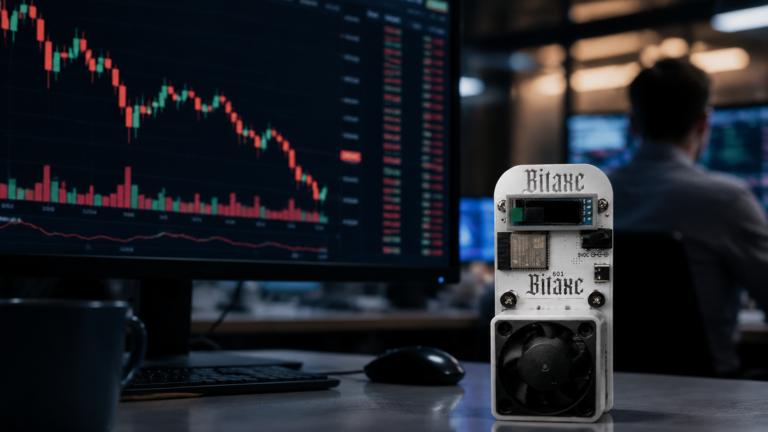
A Bitaxe miner on a desk does not care about the latest headline. It makes the user deal with physical facts. Is the power supply stable? Is the cooling good enough? Is the firmware configured properly? Is the hashrate consistent? Is the unit connected correctly? Is the user learning what mining means, or just hoping the number on the screen turns into a lottery ticket?
That slower learning curve is useful.
Bitcoin mining hardware turns Bitcoin from a ticker into something mechanical, electrical, and operational. You stop thinking only in terms of price and start noticing the system behind the price. Power becomes hashes. Hashes become shares. Probability becomes part of the experience.
That does not make price irrelevant. Price matters. It affects miners, manufacturers, buyers, and the mood of the entire market.
But price is not the whole machine.
Home Mining Is Not Trying to Beat Warehouses
A small home miner is not trying to compete with a large-scale mining farm. That comparison misses the point.
Large miners optimize for energy cost, fleet efficiency, uptime, logistics, and scale. They live and die by industrial margins. A small Bitcoin miner at home serves a different purpose.
It can teach users how Bitcoin mining works. It can make Proof of Work visible. It can show what hashrate means outside of an exchange chart or a dashboard screenshot. It can remind people that Bitcoin is not just a balance sitting on a platform.
That is where Bitcoin home mining still has a role during ugly price action.
When Bitcoin price falls, many people discover that they never really understood what they bought. They bought the chart. They bought the ticker. They bought the idea that someone else would pay more later.
Running hardware does not automatically make someone a better Bitcoiner. But it does make the network less abstract.
That is why devices such as a Bitaxe miner matter in the broader conversation around home Bitcoin mining. Not because they replace industrial mining. Not because they guarantee rewards. They do not. They matter because they lower the distance between a normal person and the machinery of Proof of Work.
SoloBitaxe sits in that same category of small Bitcoin mining hardware: useful not as a promise of profit, but as a practical way to understand what the network is actually doing.
There is value in that, even when the chart is red.
The $62K Question Is Not the Only Question
The market will keep watching the same levels. If Bitcoin price support holds, traders will call it strength. If BTC breaks lower, people will talk about a deeper correction. If it reclaims resistance, sentiment will turn again.
That is how crypto markets behave.
But Bitcoin itself faces a harder test than a short-term chart setup: does the network keep running under pressure?
Price volatility tests conviction. Mining tests machinery. The two are connected, but they are not the same thing.
A 10% selloff can change the mood of the market. It can pressure leveraged traders. It can squeeze weak hands. It can make headlines sound more important than they are.
What it does not do is stop a properly configured Bitcoin miner from doing its job.
For traders, the next question may be whether BTC holds $62,000 or reclaims $65,000.
For builders, the question is simpler.
Is the network still running?
So far, that is still the cleanest signal on the board.