
Bitcoin Mining Was Never Just About Money
A recent PANews story about Wang Chun, co-founder of F2Pool, reads almost like science fiction: an early Bitcoin miner helps build one of the world’s major mining pools, funds his own private space mission, and then plans to command a SpaceX Starship flight past Mars. According to the original report, Wang’s wealth came largely from Bitcoin mining infrastructure through F2Pool and later staking infrastructure through stake.fish. The same report says F2Pool has helped miners produce more than 1.3 million bitcoin over the years.
That is the kind of story people usually flatten into a headline: “Bitcoin millionaire goes to space.”
But that misses the more interesting point.
Bitcoin mining was never just a machine for producing coins. At its best, it has been a way for individuals to plug computation into a global monetary network and receive something back from it. Sometimes that “something” is bitcoin. Sometimes it is technical skill, social capital, infrastructure experience, or a completely different life path.
Wang Chun’s story is extreme. Most miners will not end up on a private Mars flyby. But the pattern behind it is not extreme at all. Bitcoin mining has always attracted people who want to participate directly instead of asking permission.
The strange bridge between mining and space
The PANews report describes Wang as someone who was interested in maps, travel, computers, and measurement long before Bitcoin entered the picture. It says he bought his first Bitcoin in 2011, began mining with graphics cards, and later launched F2Pool in 2013 with Mao Shixing, known in the industry as Shenyu.
That timeline matters.
Early Bitcoin mining was not clean, polished, or institutionally approved. It was messy. People used GPUs, cheap rooms, second-hand parts, improvised cooling, and a lot of patience. The people who understood it early were not simply speculating on a chart. They were learning how a new kind of infrastructure worked by touching it directly.
That is very different from buying an asset through an app.
When someone mines Bitcoin, even at a tiny scale, they are dealing with electricity, heat, firmware, network settings, hashrate, pools, block templates, probability, and hardware failure. Bitcoin mining makes the network physical. It turns an abstract idea into noise, temperature, wiring, and blinking screens.
Maybe that is why the jump from mining to private space exploration does not feel as random as it should. Mining and space both attract people who are comfortable with machines, risk, logistics, and long odds.
F2Pool was not a casino. It was infrastructure.
A lazy reading of Bitcoin mining history treats every early miner as simply “lucky.” There is some truth in that. Timing mattered. Risk appetite mattered. Being early mattered.
But luck is not enough to explain F2Pool.
A mining pool is not the same thing as a mining farm. A farm owns or operates mining machines. A pool coordinates hashrate from many miners, tracks contribution, distributes rewards, and keeps the technical backend running. The original report describes F2Pool as an infrastructure layer for miners worldwide rather than a single mining operation.
That distinction is important because it shows what Bitcoin mining really produced in its early years: operators.
Not just coin holders. Not just traders. Operators.
People learned how to run systems that had to work every hour of every day. They learned incentives because miners leave when rewards are miscalculated. They learned uptime because downtime costs real money. They learned trust because pool operators handle payouts across thousands of participants. They learned global markets because hashrate does not care much about borders.
This is why the “Bitcoin made someone rich and now he is going to space” version is too shallow. A better version is: Bitcoin mining trained a generation of infrastructure people, and some of them accumulated enough capital to act outside traditional channels.
That is a more serious story.
Home miners are part of the same arc
It is easy to look at a giant mining pool and a small home setup and treat them as completely different worlds. One is industrial. The other is personal. One measures hashrate at a massive scale. The other might be a compact Bitcoin miner sitting on a desk.
But both come from the same basic impulse: do not just watch the network, participate in it.
That is where Bitcoin home mining still matters, even in an era dominated by professional facilities and specialized Bitcoin mining hardware. A home Bitcoin mining setup is not competing with the largest farms on scale. That is not the point. The point is that people can still learn the system from the inside.
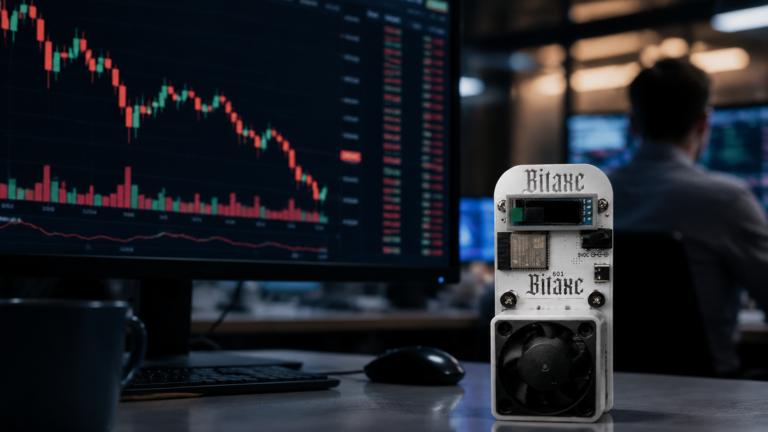
A Bitaxe miner on a shelf will not look like an industrial deployment. It will look small, maybe even unserious to someone who only thinks in megawatts. But it gives a person a real relationship with proof of work. It teaches the difference between owning bitcoin and helping run Bitcoin.
That difference matters.
Solo home mining is even more misunderstood. People often ask only one question: “What are the odds?” That is a fair question, but it is not the only one. Solo mining is also a cultural statement. It says the network is still open enough for a small operator to point hashrate at it directly, even if the probability of finding a block is extremely low.
Devices such as a Bitaxe miner or small SoloBitaxe-style setup are not trying to replace industrial mining. They represent a different layer: education, experimentation, sovereignty, and direct contact with the protocol.
Computation is becoming a personal tool again
One reason Wang Chun’s story is interesting is that it pushes back against a tired idea: that individuals are becoming less relevant as technology gets larger.
Bitcoin suggests the opposite, at least in one specific way. It showed that a person with hardware and curiosity could interact with a global system without needing a bank, broker, employer, or government agency to invite them in.
That does not mean everyone gets the same result. They obviously do not. Early miners had opportunities that later miners do not have. Industrial miners have advantages that home miners do not have. Capital still matters. Electricity prices matter. Hardware access matters. Timing matters.
But the door is not closed.
A person running Bitcoin mining hardware at home today is not recreating 2011. That era is gone. What they are doing is something more modest but still meaningful: learning how proof of work actually behaves in the real world.
This is the part many critics miss. They judge mining only by output. Did it produce a block? Did it earn a payout? Did it beat the power bill?
Those questions are valid, but they are incomplete. Mining also produces competence. It produces operators. It produces people who understand that networks are not magic. They are maintained by machines, incentives, and human persistence.
The Mars angle is not the lesson. The path is.
The PANews report says Wang previously self-funded Fram2, described as the first crewed polar orbit mission, and that the mission completed scientific experiments during a multi-day flight. It also says his planned Starship mission would fly out of the Earth-Moon system, pass Mars, and return to Earth over roughly two years, independent of NASA.
Those details are spectacular. They are also not the part most Bitcoin miners should focus on.
The real lesson is not “mining can make you rich enough to go to space.” That is the wrong takeaway and probably the least useful one.
The better takeaway is that Bitcoin mining can turn outsiders into participants. In the beginning, Wang was not a central banker, a government space official, or the head of a legacy financial institution. He was a programmer who found Bitcoin, mined it, helped build infrastructure around it, and followed that path into places that used to be reserved for states and giant institutions.
That is a very Bitcoin story.
Not because it is glamorous, but because it starts with direct participation.
Bitcoin mining still has a human scale
The industry has become more professional, and that was inevitable. ASICs replaced GPUs. Large farms replaced bedrooms. Energy contracts, firmware tuning, logistics, and capital planning became part of the business.
Still, the small miner has not disappeared.
In fact, the small miner may be more important culturally now than during the easy years. When industrial mining dominates the headlines, Bitcoin home mining reminds people that proof of work is not only a corporate activity. When mining becomes a balance-sheet discussion, the home miner brings it back to the desk, the garage, the spare room, the shelf with too many cables.
That is not nostalgia. It is useful.
Bitcoin needs large-scale miners. It also benefits from people who understand the network personally. The person running a small Bitcoin miner at home may never find a block. But they may learn enough to explain mining honestly, defend proof of work intelligently, build tools, contribute to open hardware, teach someone else, or simply stay connected to the system beyond price movements.
Wang Chun’s path from F2Pool to SpaceX is an outlier. But it points to something real: computation can give individuals a way into systems that once looked unreachable.
Bitcoin mining was never just about money. It was about proving that participation could start with a machine.