
Bitcoin Miner Inflows Are Rising. The Panic Trade Is Too Easy
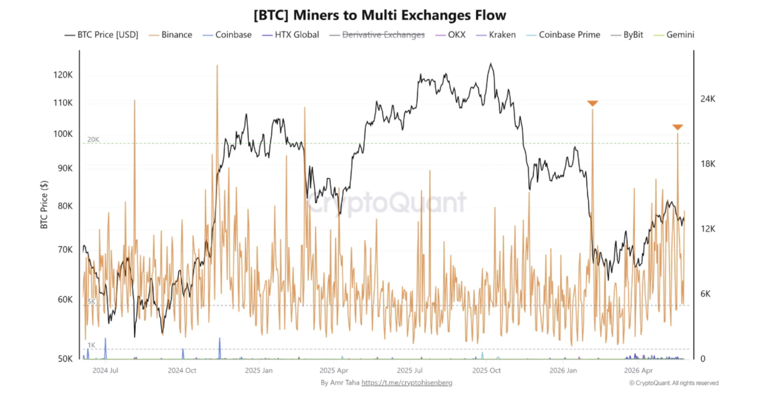
Bitcoin miners recently sent a large amount of BTC to Binance, and the number was big enough to make traders pay attention. According to the original report, miner inflows to Binance reached about 21,000 BTC on May 18. That was the second time this year that miner inflows to the exchange crossed 20,000 BTC. The previous spike was reported on February 5, when roughly 23,150 BTC moved in.
That is not a small transfer. When miners move coins to an exchange, the market usually treats it as a possible selling signal. That reaction makes sense. Miners have electricity bills, hosting costs, hardware depreciation, debt, staff, repairs, and balance sheets to manage. They are one of the few groups in Bitcoin that naturally produce BTC and often need to sell part of it to keep the operation running.
But the easiest interpretation is not always the right one.
Bitcoin miner inflows can be a warning sign. They are not the same thing as instant selling. And they are not an automatic crash signal.
Miner Inflows Deserve Attention, Not Panic
A Bitcoin miner sending BTC to Binance is worth watching. Ignoring that kind of movement would be careless. Mining is a capital-heavy business, and when margins get tight, some miners need cash. That is not bearish propaganda. That is how the business works.
The original report also said Binance’s BTC reserves rose from around 618,600 BTC on May 6 to nearly 634,000 BTC on May 26. That is a meaningful increase. It suggests more BTC was sitting on the exchange while Bitcoin was struggling to hold its broader uptrend.
Still, an exchange transfer only tells part of the story.
A miner may be preparing to sell. It may be hedging. It may be moving coins between custody setups. A company may be reorganizing liquidity across accounts. On-chain data is useful, but it does not tell you the exact intent behind every transfer.
This is where a lot of weak BTC price analysis goes wrong. It sees a large exchange inflow, draws a straight line to panic selling, and acts as if the market has already made its decision.
Markets are rarely that clean.
The Market Did Not Break on the Spot
The more interesting part is not simply that miners sent BTC to Binance. It is that the market did not immediately fall apart afterward.
If 21,000 BTC moving toward an exchange were enough by itself to break Bitcoin, the reaction should have been much more aggressive. Instead, Bitcoin looked heavy, support became more important, and traders started watching whether the $75,000 area could hold.
That is pressure. It is not proof of failure.
Bitcoin miner selling pressure can be real without being dominant. Sellers can show up without fully controlling the tape. A market can absorb supply for a while if spot buyers are still willing to step in.
That is the part many people miss. The question is not whether miners may sell. Some of them probably will. The real question is whether there is enough demand to absorb that supply without turning support into resistance.
That is why looking only at Bitcoin miners Binance flow data is too narrow. Exchange reserves matter. Spot demand matters. Derivatives positioning matters. Market structure matters.
One data point can warn you. It should not do the thinking for you.
Spot Demand Is the Cleaner Signal
The report pointed to weaker spot demand over the past two weeks and noted that Bitcoin had failed several times around the $80,000 to $81,000 range. That detail matters more than the miner inflow itself.
Miner selling becomes more dangerous when spot demand is already soft. If buyers are aggressive, miner supply can get absorbed quietly. If buyers step back, even normal miner selling can start to feel heavy.
That is the uncomfortable part of the current setup. Bitcoin does not need some dramatic miner capitulation event to test lower support. It only needs enough supply to meet a market where demand is cooling.
The report also highlighted $75,000 as an important Bitcoin price support area. If that level fails, the next area mentioned was around $70,400. These are not magic numbers. They are zones where traders watch behavior.
Do buyers step in? Do sellers press harder? Does volume confirm the move? Does price snap back quickly? Those reactions matter more than the level itself.
The technical picture also sounded cautious. The report mentioned a possible head-and-shoulders structure after repeated rejection around $80,000 to $81,000, with a lower high near $78,000 potentially acting as the right shoulder. It also noted RSI below 50, suggesting short-term momentum had weakened.
That does not mean $70,000 has to happen. It means the market has less room for lazy demand.
Industrial Mining Is a Cash Flow Machine
This is also a reminder of something many retail traders forget: large-scale Bitcoin mining is not just a hashrate race. It is a cash flow business.
An industrial Bitcoin miner does not operate like a hobbyist. It has power contracts, facilities, cooling systems, staff, repairs, firmware management, financing, equipment cycles, and sometimes shareholder pressure. Even miners that are bullish on Bitcoin may still need to sell BTC.
That is why miner behavior can look cold from the outside. A miner can believe in Bitcoin and still sell coins. A mining company can be optimistic about the network and still reduce treasury exposure. When bills are due, survival comes before ideology.
This is where Bitcoin mining pressure is different from ordinary trader selling. A trader can choose to sit on the sidelines. A miner may not always have that option.
So yes, miner inflows are worth tracking, especially when price is sitting near a major support zone. The mistake is treating those inflows as a complete forecast instead of one piece of the market.
Home Bitcoin Mining Runs on a Different Logic
There is a useful contrast here between industrial mining and Bitcoin home mining.
Industrial miners think in terms of scale, cost per terahash, energy contracts, uptime, debt, and treasury management. Home Bitcoin mining has a different rhythm. A small miner on a desk is not trying to compete with a warehouse full of ASICs. It is usually about learning the network, running real Bitcoin mining hardware, and touching Proof of Work directly.
That does not mean home mining ignores economics. Electricity still matters. Hardware quality matters. Heat, noise, stability, and setup experience all matter. A Bitaxe miner or similar device is still part of the same mining reality, not a toy version of it.
But the motivation is different.
For many home miners, solo mining is not a corporate treasury strategy. It is a probabilistic way to participate in the Bitcoin network from home. The reward outcome is uncertain, but the connection to the network is real.
That is why home Bitcoin mining keeps attracting attention even when industrial miners are under pressure. It brings mining back down to a human scale. Not every miner has to be a warehouse. Sometimes one small device is enough to make the mechanics of Bitcoin feel real.
SoloBitaxe belongs in that broader category of compact home mining hardware, but the larger point is not about one brand. It is about the gap between mining as balance-sheet management and mining as direct network participation.
The Better Read on Miner Selling Pressure
The lazy takeaway from this report is simple: miners sent BTC to Binance, so Bitcoin must crash.
The better takeaway is more useful: Bitcoin miner inflows are rising, spot demand has weakened, and key support levels matter more than usual.
That is a very different read.
If spot demand returns, Bitcoin miner selling pressure can be absorbed. If spot demand keeps fading, the same amount of supply can become a much bigger problem. The market is not only reacting to how many coins miners send to exchanges. It is reacting to whether buyers are willing to take those coins at current prices.
For anyone watching Bitcoin miner inflows, that is the real signal. Do not just ask how much BTC moved. Ask what happened after it moved.
Did price break down? Did buyers absorb the supply? Did exchange reserves keep rising? Did spot volume confirm weakness? Did support hold?
That is how miner inflow data becomes useful instead of just scary.
Bitcoin mining has always had a selling side. Pretending otherwise is naive. But treating every miner transfer as an automatic crash warning is just another kind of bad analysis.
The market is not asking for panic. It is asking for a cleaner read.