Bitcoin Mining Difficulty Is Rising: Why Home Bitcoin Mining Still Matters
Bitcoin mining is entering a more demanding phase.
According to Bitcoin.com News, Bitcoin mining difficulty rose to 136.61T on May 15, 2026, up 3.12% from the previous adjustment. At the same time, miner revenue came under pressure. Hashprice dropped from $38.97 per PH/s per day on May 14 to around $35.29 per PH/s per day, a decline of about 9.44%. Transaction fees also remained a very small part of miner revenue, accounting for only 0.59% of total block rewards over the previous 24 hours.
These numbers point to a clear reality:
Bitcoin mining is becoming harder, and miner profit margins are being squeezed.
But that does not mean mining is losing its value. Instead, it pushes us to rethink an important question:
Should the future of Bitcoin mining belong only to large-scale mining farms?
Rising Mining Difficulty Reflects Bitcoin’s Security
A higher Bitcoin mining difficulty is not necessarily a bad thing.
It means more computing power is competing to secure the network. The more hashrate behind Bitcoin, the more expensive it becomes to attack the network. In that sense, rising difficulty is also a sign of Bitcoin’s growing security.
For miners, however, higher difficulty means the same amount of hashrate earns less expected revenue.
When this is combined with BTC price volatility, electricity costs, hardware depreciation, and cooling pressure, mining becomes increasingly competitive.
Bitcoin.com News also noted that for miners already operating on thin margins, the current environment leaves very little room for error. Efficiency and energy cost are becoming more important than ever.
This is where the mining industry is changing.
For years, many people have understood Bitcoin mining as a game of bigger facilities, higher hashrate, denser machines, and cheaper electricity.
But mining does not have to belong only to massive data centers.
It can also belong to everyday users, hardware enthusiasts, home miners, and anyone who wants to participate directly in the Bitcoin network.
Home Mining Is Not Only About Profit
When people talk about home Bitcoin mining, the first question is usually:
Is it profitable?
That question matters, but it is not the only question.
For large mining farms, mining is a highly financialized business. They focus on electricity rates, scale, cash flow, financing costs, and hardware payback periods.
For home miners, mining also carries another meaning:
It is a way to participate in the Bitcoin network.
A small miner may not compete with industrial mining farms in scale, but it can still contribute hashrate, connect to the network, support proof-of-work, and help ordinary users better understand how Bitcoin actually works.
This is one reason why Bitaxe-style open-source miners, low-power ASIC miners, and home Bitcoin miners have gained attention in recent years.
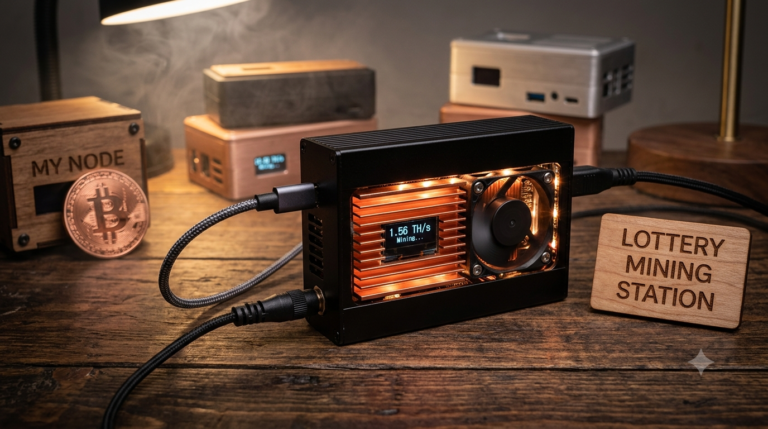
They bring mining back from industrial facilities to personal desks, home offices, garages, and workshops.
Home mining is not a replacement for large-scale mining farms. It is a meaningful complement to Bitcoin’s decentralized spirit.
When Difficulty Rises, Efficiency Matters More Than Scale
As Bitcoin mining difficulty continues to rise, inefficient machines are pushed out faster.
This means the future of mining hardware should not be judged only by raw hashrate. Other factors matter just as much:
Is the device stable?
Is the power consumption reasonable?
Is the cooling reliable?
Is the noise level suitable for home use?
Is it easy to set up and maintain?
Can it run 24/7 without constant attention?
For home miners, these factors can be even more important than maximum hashrate.
A home-friendly miner should not feel like industrial equipment. It should be compact, power-conscious, easy to configure, stable in daily operation, and accessible to users who want a lower barrier into Bitcoin mining.
This is the direction SoloBitaxe is focused on.
SoloBitaxe is not trying to turn home users into large mining farms. Instead, it aims to help more people participate in Bitcoin mining in a lighter, simpler, and more sustainable way.
Mining Is Not Just About Short-Term Profit
Bitcoin mining is always influenced by three major variables:
BTC price;
Network difficulty;
Energy cost.
These factors constantly change, which means miner revenue will always move in cycles.
The Bitcoin.com News report shows this clearly: when BTC price falls and mining difficulty rises, miner revenue can come under pressure quickly.
But if mining is viewed only through short-term profitability, it is easy to miss its deeper long-term value.
Mining is part of Bitcoin’s issuance mechanism.
Mining is part of Bitcoin’s security model.
Mining is also a way for ordinary people to participate in Bitcoin infrastructure.
For home miners, mining can be a learning experience, a technical practice, a personal conviction, and a direct contribution to a decentralized network.
In that sense, small hashrate does not mean no value.
Every hash is part of the Bitcoin network.
The Future SoloBitaxe Sees
We believe the future of Bitcoin mining will not have only one form.
Large mining farms will continue to exist, and they will continue to provide massive industrial-scale hashrate.
At the same time, home mining, small miners, open-source hardware, and individual nodes will become increasingly important.
If Bitcoin’s future is a more open and decentralized financial network, then mining should not be concentrated only in the hands of a few large institutions.
SoloBitaxe is focused on another possibility:
Bringing Bitcoin mining back into the home.
Helping ordinary users participate directly in the network.
Making small miners a meaningful part of the Bitcoin ecosystem.
As mining difficulty rises, the industry becomes more demanding.
But this is exactly why efficiency, stability, low power consumption, and ease of use matter more than ever.
The future home miner does not need to be the biggest machine.
It needs to be smarter, more stable, and better suited for everyday users.
Conclusion
The rise in Bitcoin mining difficulty is a reminder that the industry is maturing.
Lower miner revenue does not mean mining has lost its value. It means mining is entering a phase where efficiency, professionalism, and stronger standards matter more.
For SoloBitaxe, this is exactly why home mining still matters.
Bitcoin does not belong only to exchanges, funds, and large mining farms.
It also belongs to everyone willing to run hardware, contribute hashrate, understand the network, and participate in it.