Bitcoin Miners’ AI Pivot Is Entering Its Hardest Phase
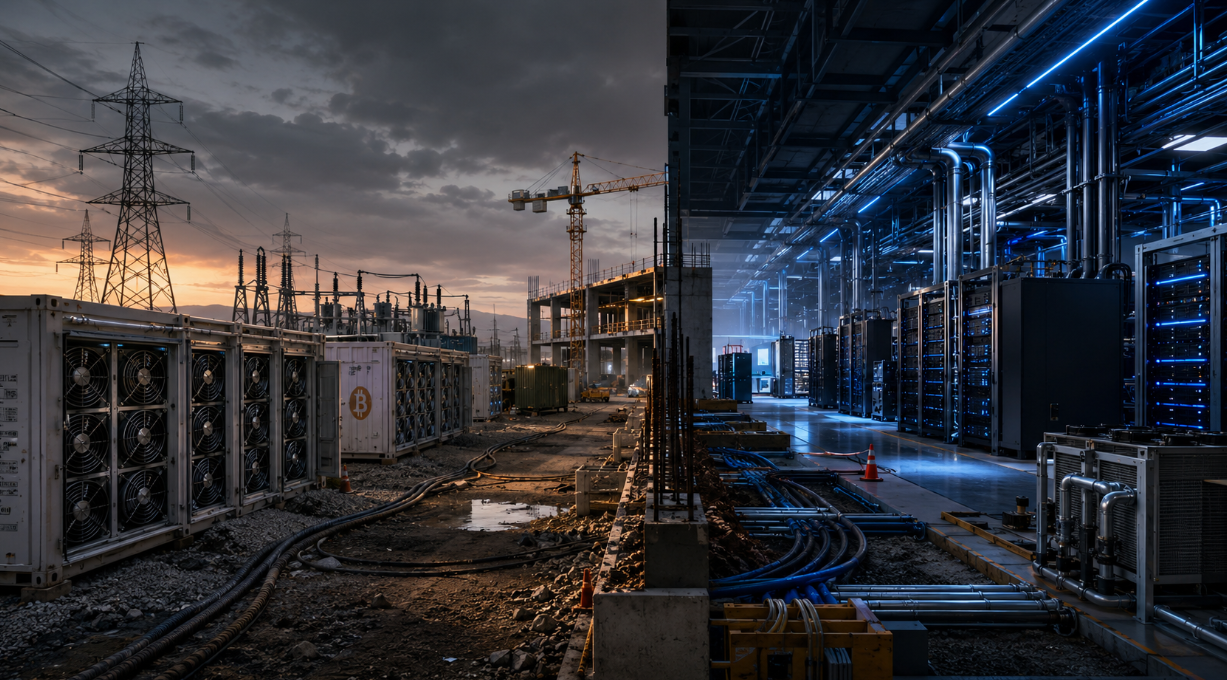
For the past two years, Bitcoin miners have pitched investors on a simple idea: they already control the power and land AI companies need.
The pitch worked. Mining firms announced large data center projects, signed long-term agreements and began presenting themselves as AI infrastructure providers.
Now they have to deliver.
A June 16 analysis from VanEck estimates that the miners in its study have completed only about 25% of the AI and high-performance computing capacity they have leased. The firm also estimates a near-term funding gap of roughly $50 billion. If current development plans move ahead, long-term capital needs could reach $221 billion.
These are model-based estimates, not confirmed industry debt. VanEck compared projected construction costs with available cash and did not include future operating cash flow or Bitcoin mining revenue. Some projects may be delayed, redesigned or dropped altogether.
Even so, the report points to a clear change in how these companies should be judged. Power rights and contract announcements are no longer enough. The real test is whether miners can finance, build and operate facilities that customers are willing to accept and pay for.
Power Is Only the Starting Point
AI data center projects are often reduced to one headline number: megawatts.
That can hide more than it reveals.
A company may control land and future power capacity without having a completed grid connection. A site may already be energized but still lack the cooling, networking, backup systems and electrical redundancy required for high-density AI workloads.
Bitcoin mining facilities are built for flexibility. Operators can shut down machines when electricity prices rise or when the grid comes under pressure.
AI customers usually expect enterprise-grade reliability, advanced cooling and dependable fiber connectivity. Reaching that standard takes time and significant capital.
Contract announcements create another source of confusion. A long-term lease may carry a multibillion-dollar headline value, but revenue starts only after the facility is completed, accepted by the customer and placed into service.
Before that point, the agreement represents future business rather than current performance.
TeraWulf, IREN and Bitfarms Are Not at the Same Stage
The phrase “Bitcoin miners moving into AI” makes the transition sound more uniform than it is.
TeraWulf has already moved beyond the planning stage. By March 31, 2026, its Core42 leases had begun, supporting 60 MW of operating critical IT capacity. The company recognized $21 million in HPC lease revenue during the first quarter.
Its larger Fluidstack projects were still under construction, and none of those leases had started by the end of March.
Google has agreed to support certain Fluidstack lease obligations once the relevant leases begin. That support may improve TeraWulf’s access to financing, but it does not remove construction or delivery risk. The arrangement also included warrants issued to Google, adding a potential dilution cost for existing shareholders.
IREN is building AI revenue more quickly, but its latest results also show the strain of the transition.
For the quarter ended March 31, 2026, total revenue fell from $184.7 million to $144.8 million. Bitcoin mining revenue dropped from $167.4 million to $111.2 million, while AI Cloud Services revenue rose from $17.3 million to $33.6 million.
The decline was partly tied to lower Bitcoin prices and the retirement of mining equipment ahead of new GPU installations. IREN also recorded $140.4 million in non-cash impairments, mainly related to retired miners.
This is the uncomfortable middle of the transition: mining capacity comes offline before the replacement AI infrastructure is earning revenue at scale.
IREN’s agreement with Microsoft has an estimated value of about $9.7 billion over an average five-year term. But as of March 31, future tranches had not yet been delivered or accepted.
The contract matters. The accounting remains simple: revenue follows delivery.
Bitfarms is at an earlier stage.
As of March 27, the company reported a 2.2 GW power pipeline, including 648 MW of secured capacity and 1,513 MW under development. It also said it had not yet signed an HPC data center lease.
That power portfolio may eventually support a meaningful AI business. For now, it remains a development asset rather than an operating data center platform.
These companies are often placed under the same AI narrative, but their operating positions are very different.
Financing May Matter More Than Scale
AI data centers require far more capital than traditional mining sites.
The cost goes well beyond buildings and power connections. Developers may need new substations, transformers, liquid cooling systems, backup power, networking equipment and customer-specific hardware. In some cases, they must finance the GPUs as well.
The structure of that financing matters.
Customer prepayments can reduce the amount of outside capital required. Debt backed by a creditworthy tenant may offer better terms than unsecured borrowing. Joint ventures can spread both cost and risk.
Other structures carry less obvious costs.
Convertible debt can ease short-term interest pressure but create future dilution. Warrants give part of the upside to a financing partner. New equity strengthens the balance sheet while reducing existing shareholders’ ownership.
Bitcoin holdings may also become part of the funding plan. A miner can sell BTC, borrow against it or preserve it while raising capital elsewhere. Each choice changes the company’s exposure to Bitcoin and the financial risk attached to its AI expansion.
A smaller project with committed financing and a strong customer may prove more valuable than a larger pipeline that still depends on future fundraising.
The Market Has to Measure Delivery
Mining companies have already shown that they can secure power and attract major AI customers.
The market now needs harder evidence.
Useful disclosures include the share of contracted capacity already delivered, actual lease start dates, recognized AI revenue, construction progress, budget changes and customer acceptance.
Terminology matters as well.
Total site power can be far larger than the electricity available to computing equipment. Planned capacity should be separated from energized capacity. Annualized revenue targets are not reported revenue, and long-term contract value is not cash already earned.
Bitcoin miners do have an advantage in the AI infrastructure race. They control power, land and teams with experience building energy-intensive facilities.
That gets them to the starting line.
The companies that succeed will be the ones that can raise capital without weakening their balance sheets, finish construction, meet customer standards and turn contracted capacity into recurring revenue.
The story is no longer about what miners have announced.
It is about what they can deliver.
Primary sources: VanEck, TeraWulf SEC filings, IREN SEC filings and Bitfarms’ annual report.