
Bitcoin Isn’t Crashing Because of Wall Street. It’s Losing the Story.
The lazy explanation is always the easiest one.
Bitcoin drops, and everyone starts looking for one villain. A Wall Street headline. ETF outflows. A bank tokenization project. A corporate holder moving coins. A chart level breaking. One clean reason makes the market feel easier to understand.
But this selloff does not look like a one-headline event.
Bitcoin is not falling simply because banks are working on tokenized deposits. It is not falling only because ETFs have seen redemptions. It is not falling only because traders are watching Bitcoin miner inflows or worrying about Bitcoin miner selling pressure. Those things matter around the edges, but they do not explain the whole mood.
The more useful answer is also less comfortable: Bitcoin has lost the market’s strongest story for the moment.
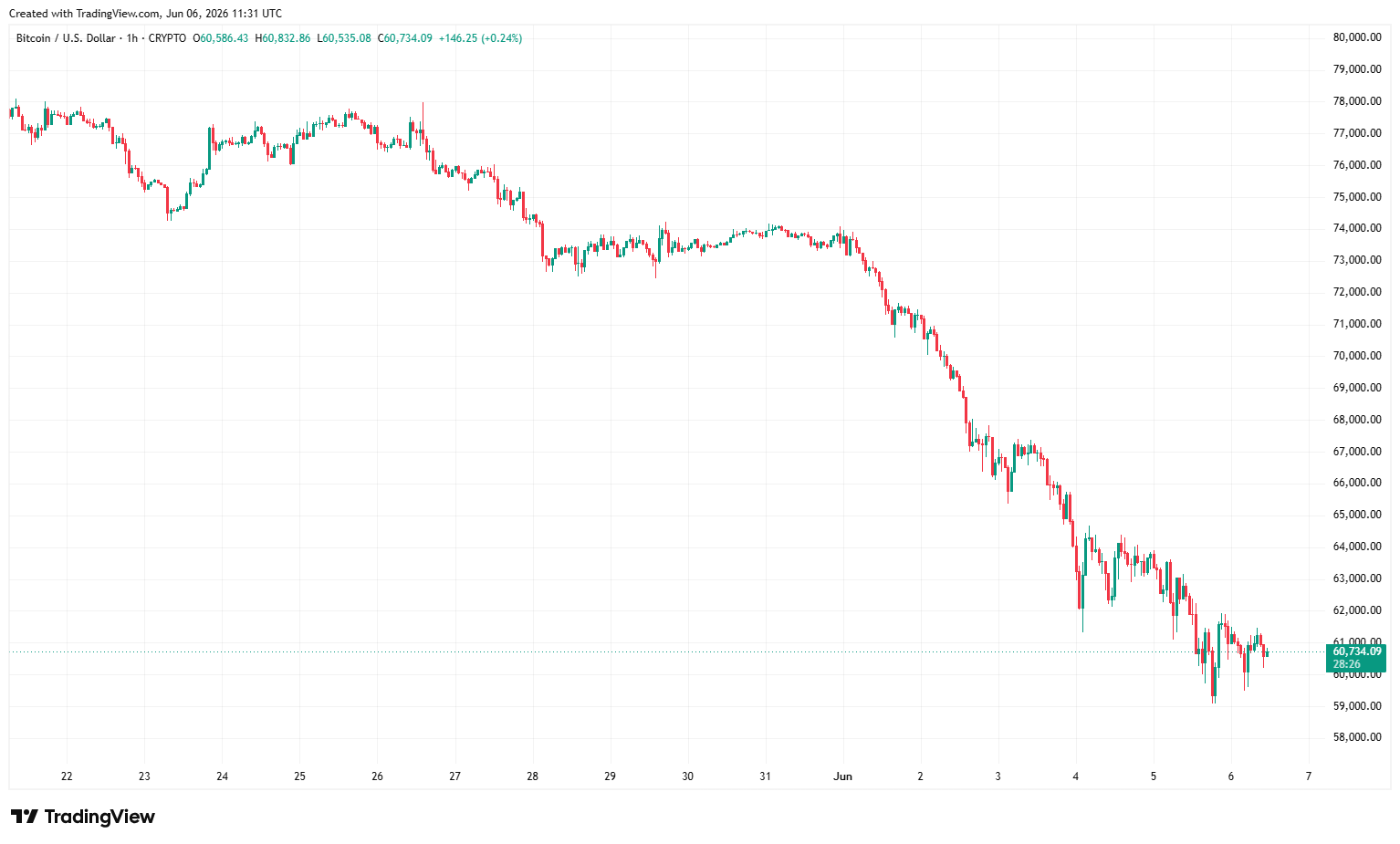
According to the original report, tech stocks have kept pushing Wall Street higher while Bitcoin has struggled to hold momentum. Capital is chasing AI, semiconductor demand, and the kind of private-market tech names and IPO stories that make fund managers feel close to the next growth cycle. Reuters put numbers behind that mood: Bitcoin had dropped sharply for the week, was down meaningfully for the year, and major Bitcoin ETFs had seen notable outflows.
That does not mean Bitcoin is broken.
It means the next dollar looking for momentum has found a louder trade.
Bitcoin is not being punished. It is being ignored.
There is a difference between a market that hates an asset and a market that simply stops paying attention to it.
Bitcoin had a powerful run of narratives over the last few years: spot ETFs, institutional access, corporate treasury accumulation, political support, and the idea that digital gold had finally become a mainstream asset. Those stories mattered. They brought in new buyers, media coverage, and investors who did not want to hold private keys or run nodes but still wanted exposure.
The problem is that markets do not stay loyal just because last year’s story worked.
AI gives investors something Bitcoin currently does not: visible corporate spending, datacenter buildouts, chip demand, IPO excitement, and a steady stream of new public-market hooks. That does not make AI “better money.” It just makes AI easier to explain inside a portfolio meeting.
Bitcoin’s strongest arguments are harder to package. It settles value without a bank account. It runs on proof-of-work. It does not need a boardroom to approve the next block. Those are serious properties, but they do not always win a short-term capital rotation.
For now, Bitcoin is not mainly losing a technical argument.
It is losing attention.
Wall Street wants crypto rails, not Bitcoin’s rules.
The banking side of this story is more interesting than the price headline.
Major U.S. banks are reportedly working on a shared tokenized deposit network through The Clearing House. The basic idea is straightforward: represent traditional bank deposits as blockchain-based tokens, let them move faster around the clock, and keep the money inside the regulated banking system.
That is not Wall Street suddenly adopting Bitcoin’s worldview.
Banks do not need Bitcoin’s rules to like faster settlement. They can look at stablecoins, see 24/7 movement, faster transfers, and programmable money, then ask the obvious question: why should that activity leave the banking system?
Tokenized deposits are a bank-native response to that pressure. They are not a rebellion against banks. They are banks trying to make their own deposits move more like crypto rails without giving up the customer relationship.
That is the part many crypto headlines blur. Wall Street may be learning from crypto, but learning is not surrender. The banks are basically saying: we like the speed, we like the settlement model, but we want the deposits, the clients, and the control to stay with us.
That is not bullish or bearish for Bitcoin in a simple way. It is a reminder that traditional finance can borrow pieces of crypto infrastructure without adopting Bitcoin’s permissionless design.
Stablecoins are the threat banks actually understand.
Bitcoin still gets the big headlines, but stablecoins are the pressure point banks can feel directly.
For years, many outsiders treated stablecoins as exchange plumbing. Traders used them to move in and out of positions. Offshore markets relied on them because banking access was slow, limited, or unreliable. That was the old view.
The newer reality is broader. Stablecoins are becoming payment tools, treasury tools, and dollar rails for users who do not want to wait for bank hours. In some markets, they are not really a crypto trade at all. They are simply the fastest practical way to move dollars.
Banks understand that threat because deposits are not just numbers on an app screen. Deposits are the raw material of lending, liquidity management, and the banking business model itself.
So when banks build tokenized deposit networks, the real target is not Bitcoin. The target is the part of crypto that competes with bank payments and bank deposits.
That is why this story should not be read as “Wall Street is bullish on Bitcoin.” A cleaner read is this: Wall Street has accepted that payment rails are changing, and banks do not want crypto companies to own the next layer of dollar movement.
BTC price analysis misses something when it only watches flows.
Most BTC price analysis starts in the same place: ETF flows, leverage, support levels, liquidations, miner balances, and exchange deposits.
That work matters. Bitcoin price support is partly psychological and partly mechanical. If buyers do not show up at key levels, the chart can deteriorate quickly. If ETFs keep bleeding capital, the market has to absorb that pressure somewhere. If Bitcoin miner inflows to exchanges rise during a weak tape, traders will naturally worry about Bitcoin miner selling pressure.
The same goes for searches around “Bitcoin miners Binance.” Most people searching that phrase are trying to understand whether miners are sending coins to a liquid exchange venue, and whether those movements could add near-term sell pressure.
Those signals are worth watching, but they can also make the market look more mechanical than it really is.
The bigger problem right now is narrative liquidity. Bitcoin does not just need bids. It needs a reason for the next wave of capital to care. When AI, semiconductors, and high-profile tech listings dominate the market’s imagination, Bitcoin has to fight for attention before it can fight for price.
That is why this selloff feels different from a normal leverage flush. It is not only about forced sellers. It is about investors asking, sometimes quietly, whether Bitcoin still has the strongest story in the room.
Bitcoin mining is the part traders keep skipping.
Price traders look at flows. Banks look at payment rails. Bitcoin mining people tend to look at something less glamorous: whether the network keeps clearing blocks.
That sounds boring until the market starts panicking. Then boring becomes useful.
During a selloff, the Bitcoin network does not stop because the narrative got weaker. Blocks still arrive. Miners still compete. Difficulty adjusts. Hardware still turns electricity into hashes. The machine keeps moving even when the chart looks ugly.
This is where Bitcoin mining gives a different lens from pure price speculation. A Bitcoin miner is not just a bet on a chart. It is a physical connection to the network. That distinction matters for people interested in Bitcoin home mining or home Bitcoin mining, because the point is not only to watch a ticker. It is to understand how the system actually runs.
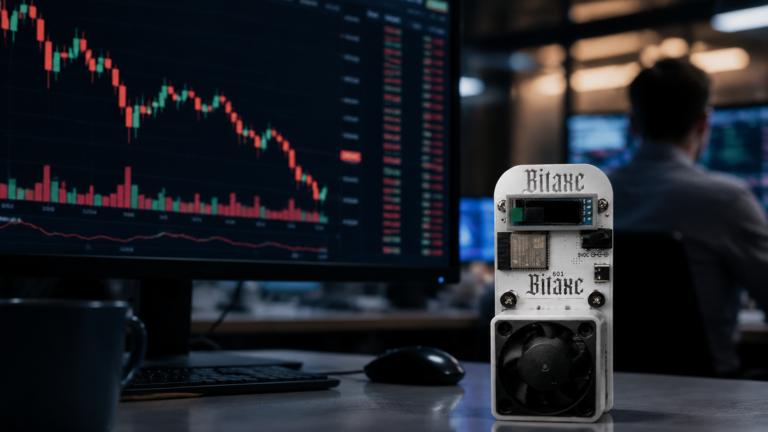
A Bitaxe miner is a good example of this mindset. It is not about pretending a small device can beat industrial mining farms. It is about making proof-of-work visible at human scale. Solo mining is probabilistic, and no serious person should present it as guaranteed income. But as a learning tool, a participation signal, and a way to make Bitcoin less abstract, small-scale Bitcoin mining hardware has a real role.
Projects like SoloBitaxe sit in that quieter corner of the market: away from ETF flow headlines, AI rotation trades, and bank tokenization stories, but close to the hardware reality that Bitcoin still depends on miners.
A weaker price story is not a broken network.
Bitcoin has a narrative problem right now. It is better to admit that plainly.
The market loves simple stories, and Bitcoin’s current story is not simple. It is no longer early enough to be dismissed as a strange internet asset. It is not new enough to excite growth investors the way AI does. It is not bank-friendly enough to be absorbed cleanly into traditional finance. It is not stable enough to behave like a standard macro hedge every quarter.
That awkwardness has always been part of Bitcoin.
Bitcoin sits in an uncomfortable place: too financial for some technologists, too technical for many investors, too independent for banks, and too volatile for conservative capital. In strong markets, that tension looks like upside. In weak markets, it looks like confusion.
But confusion is not failure.
The better question is whether Bitcoin’s basic function has changed. Are blocks still being mined? Can users still verify settlement without asking a bank? Is the supply schedule still intact? Is proof-of-work still doing what it was designed to do?
If the answer is yes, then the price story and the network story should not be collapsed into one lazy conclusion.
The next Bitcoin story may be smaller and more physical.
The next strong Bitcoin narrative may not come from another Wall Street headline.
It may come from people getting tired of treating Bitcoin as just another line item in a brokerage account. ETFs are convenient, but they also make Bitcoin feel like any other financial product. That convenience brings capital, but it can also flatten the thing that made Bitcoin different in the first place.
A quieter countertrend is already visible: people running nodes, learning self-custody, testing hardware, experimenting with home mining, and trying to understand the network by touching some part of it directly.
That is not as flashy as AI stocks or a SpaceX IPO. It does not produce the same kind of headline. But it may matter more for Bitcoin’s identity than another round of institutional price targets.
The banking system can copy faster settlement. Stablecoins can compete for dollar movement. AI can steal the market’s attention. Bitcoin mining pressure can hit margins. ETF flows can turn against the market for a while.
None of that changes what Bitcoin is at the protocol level.
If capital is chasing the loudest story, Bitcoin does not need to become louder. It needs to keep proving the one thing the chart cannot show: the network still clears blocks without asking Wall Street for permission.