
Bitcoin Is Not Broken: What the “Dog With Fleas” Comparison Gets Right About This Market
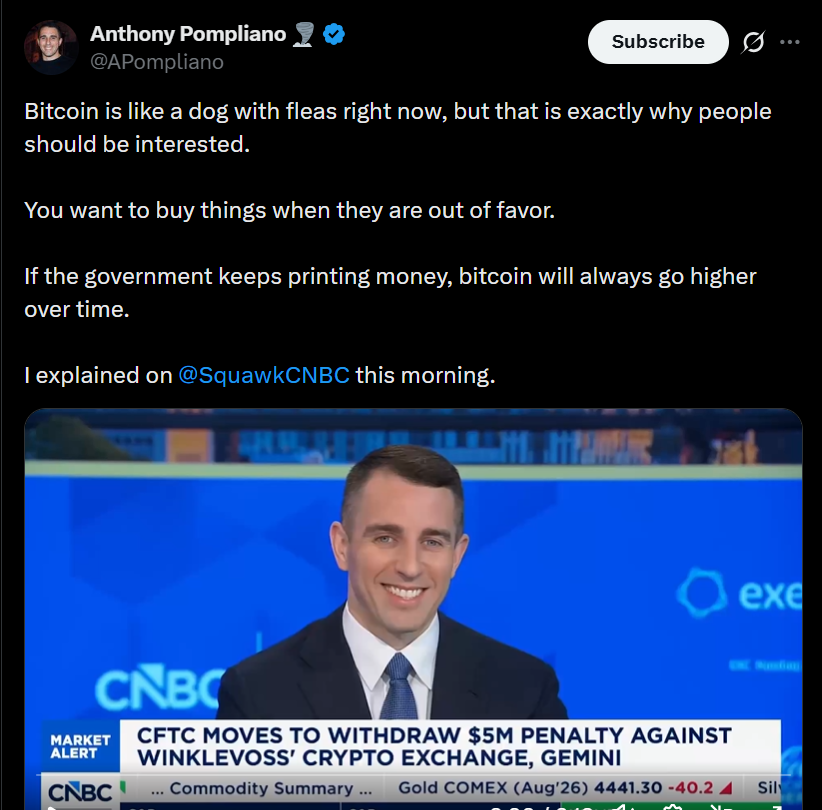
Anthony Pompliano recently compared Bitcoin to “a dog with fleas” during a CNBC Squawk Box interview.
It is not the kind of phrase Bitcoin bulls usually enjoy hearing. Bitcoiners prefer stronger images: digital gold, pristine collateral, freedom money, a hedge against debasement. A dog with fleas sounds dirty, tired, and unpopular.
But that is exactly why the comparison works.
Pompliano was not saying Bitcoin is dead. He was pointing out something more uncomfortable: Bitcoin is currently not the shiny trade in the room. AI stocks have captured the market’s imagination. Investors are chasing strength, not boredom. The momentum trade is elsewhere.
And yet, that may be the real story.
Bitcoin does not need to look pretty every month to remain important. In fact, some of the most serious moments in Bitcoin’s history have happened when the broader market stopped caring.
The Fact: Bitcoin Is Out of Fashion Again
The original report says Pompliano acknowledged Bitcoin’s recent weak performance and compared it to a “dog with fleas.” He also argued that investors often want to buy assets when they are unloved, because over time those assets can come back into favor.
That is not a new idea in markets. But applied to Bitcoin, it hits differently.
Bitcoin has always moved between obsession and neglect. In one phase, everyone wants exposure. In another phase, the same asset is treated like old news. The technology does not change that quickly. The network does not suddenly forget how to produce blocks. The emotional temperature changes faster than the underlying system.
Right now, AI has the attention.
That makes sense. AI has real momentum, real capital flows, and a simple story Wall Street can understand. Productivity. Chips. Data centers. Software margins. The narrative is clean.
Bitcoin’s story is messier. It involves monetary policy, self-custody, mining, energy, volatility, regulation, and a culture that does not always fit neatly into institutional language.
So when Bitcoin underperforms while AI stocks run, the market calls Bitcoin weak.
A Bitcoiner might call it normal.
The Opinion: Ugly Does Not Mean Broken
The “dog with fleas” metaphor is useful because it separates two things the market often confuses: bad sentiment and broken fundamentals.
Bad sentiment is obvious.
People get tired of Bitcoin when the chart stops rewarding them. Media coverage cools down. New investors get impatient. Traders rotate into whatever is moving faster.
Broken fundamentals would be different.
That would mean the network stops functioning, mining becomes irrelevant, users disappear, or Bitcoin’s monetary rules lose credibility.
That is not what the metaphor suggests.
A dog with fleas has a problem. It may look rough. It may need time and treatment. But it is still a dog. The issue is external and temporary, not necessarily fatal.
This is the part many casual observers miss. Bitcoin can be unattractive from a market timing perspective while still remaining structurally meaningful as a monetary network.
Those are not the same thing.
The Bigger Issue Is Dollar Debasement, Not Daily Price Action
Pompliano also connected Bitcoin’s potential recovery to continued fiat money creation. That argument has been part of the Bitcoin thesis since the beginning.
The simple version is this: if governments continue expanding the money supply and weakening fiat purchasing power over time, scarce assets become more relevant.
That does not mean Bitcoin moves up in a straight line. It does not mean every correction is a buying opportunity. It does not mean Bitcoin is immune to liquidity shocks, leverage washouts, or investor panic.
But it does explain why Bitcoin keeps returning to the center of macro conversations.
Bitcoin is not just another tech trade. It is not a startup stock. It is not an AI proxy. It is a monetary asset with a fixed issuance schedule, secured by Proof of Work.
That is why its market behavior often looks strange to traditional investors.
It can trade like a risk asset in the short term and still be discussed as a monetary hedge in the long term. Both can be true. That contradiction frustrates people who want Bitcoin to fit into one clean category.
Bitcoin refuses to do that.
What This Means for Bitcoin Mining
When Bitcoin looks ugly, mining becomes easier to misunderstand.
During euphoric markets, everyone wants to talk about mining profitability, hashrate growth, and the next powerful Bitcoin mining hardware. During cold markets, people assume mining interest disappears.
That is too simple.
Industrial miners are obviously sensitive to margins. Power costs, machine efficiency, difficulty adjustments, and capital structure matter. Large mining companies are not immune to market cycles.
But Bitcoin mining is not only an industrial business.
It is also the physical process that connects energy, hardware, and the network’s security model. That part does not disappear because sentiment weakens.
This is where home Bitcoin mining deserves more attention.
A person running a small Bitcoin miner at home is not trying to compete with a public mining company. That is the wrong frame. The point is not scale. The point is participation.
A home miner learns how Bitcoin actually works. They see the relationship between electricity, heat, hashrate, pool settings, firmware, noise, and uptime. They stop thinking of Bitcoin as just a ticker and start seeing it as a live network.
That is a very different kind of education.
Home Mining Is a Quiet Rejection of Pure Speculation
Bitcoin home mining is not popular because it is the easiest way to make money. In many cases, it is not.
It is popular with a specific type of Bitcoiner because it makes the network tangible.
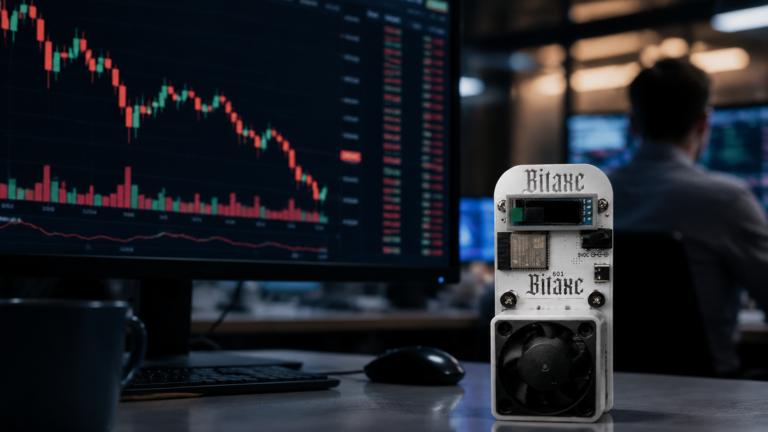
A Bitaxe miner on a desk is not a Wall Street product. It is not a leveraged ETF. It is not a token launch. It is a small piece of Bitcoin mining hardware that lets someone interact with Proof of Work directly.
That matters in a market increasingly dominated by financial wrappers.
The more Bitcoin becomes institutionalized, the more important it is that ordinary users still have ways to touch the base layer. Running a node, holding keys, experimenting with solo mining, and learning mining hardware are all part of that culture.
This is where projects and communities around tools like the Bitaxe miner and SoloBitaxe fit into the broader picture. Not as a replacement for industrial mining, but as a reminder that Bitcoin was never meant to be only a Wall Street asset.
Home mining keeps the conversation grounded.
It reminds people that Bitcoin is not just price exposure. It is a working system.
The Industry Impact: Bitcoin Is Becoming Less Exciting, More Serious
There is a strange thing that happens as markets mature.
The early excitement fades. The memes become less shocking. The easy narratives stop working. People who only came for fast gains leave.
That can look like weakness.
But it can also be a sign that the market is becoming more serious.
Bitcoin does not need constant hype to survive. Actually, the hype often makes Bitcoin harder to understand. It attracts the wrong kind of attention: people looking for a quick trade, a clean narrative, or a guaranteed outcome.
Bitcoin offers none of that.
It offers a monetary network with strict rules, open participation, and a security model that depends on real-world cost.
That is less glamorous than AI stocks ripping higher.
It is also harder to kill.
The “Bitcoin dog” metaphor may sound bearish on the surface, but it captures something honest. Bitcoin is not always clean, popular, or easy to hold through. Sometimes it looks rough. Sometimes it smells like disappointment. Sometimes the market wants something newer and shinier.
But ugly is not the same as irrelevant.
And in Bitcoin, the moments when everyone looks away are often the moments when the signal gets easier to hear.