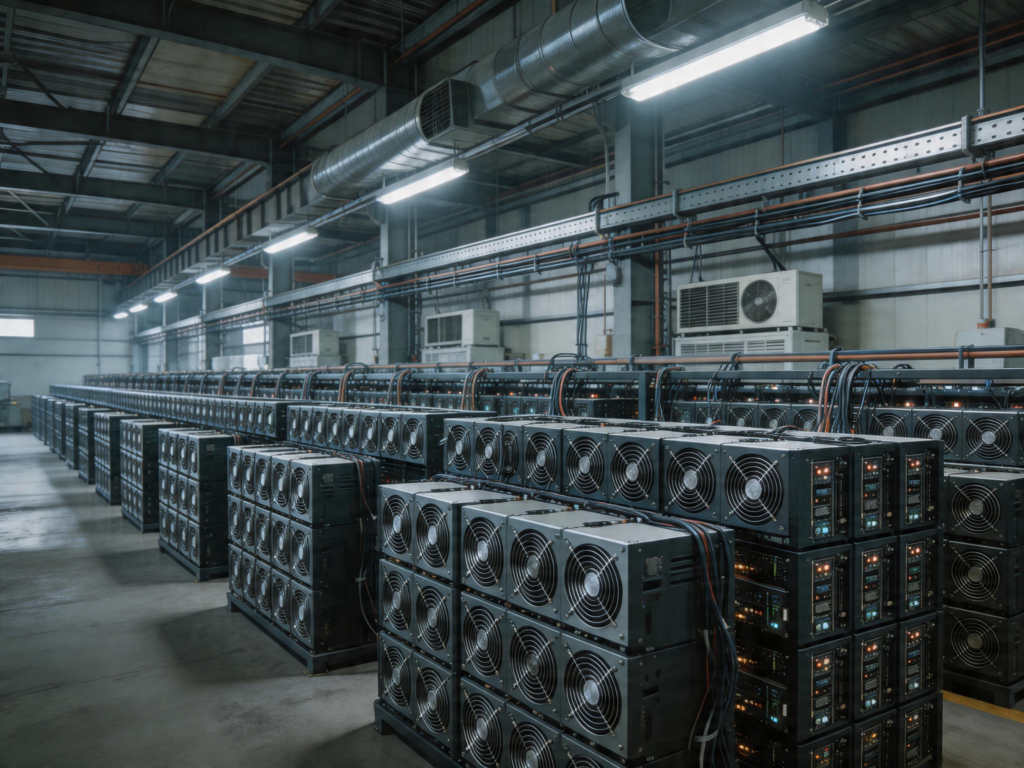
Bitcoin is now past the halfway point to its 2028 halving, and U.S. miners are grappling with a triple threat: soaring hardware costs from new tariffs, persistently low hashprice, and concentrated selling pressure from public mining firms.
U.S. Miner Hardware Costs Surge 47% Section 232 tariffs on steel, aluminum, and copper derivatives—effective April 6—have added a 25% levy to critical mining infrastructure. Combined with existing 21.6% tariffs on ASIC imports from Southeast Asia, the total cost to deploy a single mining rig has jumped an estimated 47%. A flagship Antminer S21 XP now faces roughly $1,600 in additional metal tariffs alone, while mining containers see cost spikes of $10,000 to $25,000 per unit. With public miners already reporting all-in production costs near $74,600 per BTC, the new tariff burden could push breakeven levels toward the $82,000–$85,000 range. Hashprice currently hovers between $29–$30 per PH/s per day, marking a five-year low. The U.S. controls approximately 38% of global hashrate, but if this cost disadvantage persists, hashrate migration toward zero-tariff regions like Kazakhstan and Russia becomes a tangible risk.
Halving Cycle Midpoint: Pivot to AI Accelerates With roughly 105,000 blocks remaining until the April 2028 halving, the block subsidy will soon shrink from 3.125 BTC to 1.5625 BTC—cutting daily issuance from ~450 BTC to ~225 BTC. Facing compressed margins, firms like TeraWulf and Core Scientific are pivoting aggressively, signing multi-billion-dollar AI hosting deals to convert mining sites into high-performance computing centers.
ETF Demand Meets Miner Selling Spot Bitcoin ETFs saw $614.8 million in net inflows on April 9–10, culminating in an $871 million weekly inflow—the strongest showing since January. Strategy added another 13,927 BTC at an average price of ~$71,902. However, this demand was met with significant miner distribution: Marathon sold 15,133 BTC in March (~$1.1 billion), Riot liquidated 3,778 BTC in Q1 (avg. $76,626), and Cango offloaded 2,000 BTC. This supply overhang has repeatedly capped BTC rallies near the $74,500–$76,000 resistance zone.
Industry Take As large-scale miners are forced toward AI infrastructure by ballooning costs, the antifragility of the home miner comes into focus. Without massive capital expenditures, the retail miner running efficient, open-source hardware with flexible power strategies may represent a more resilient path to participating in the Bitcoin consensus layer.




Byadmin