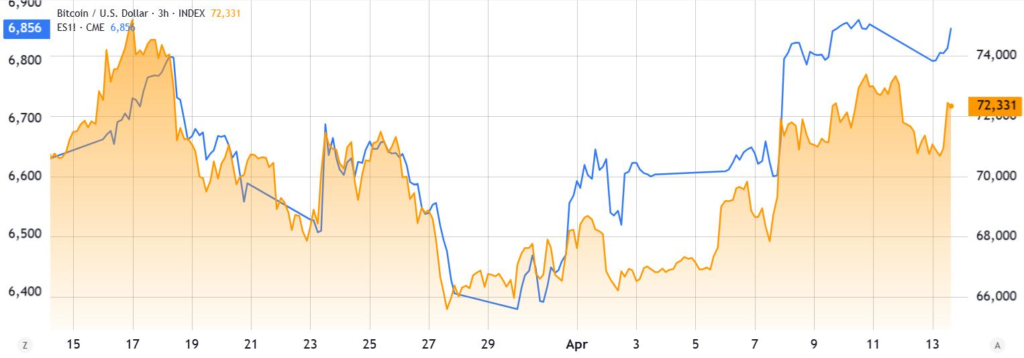
Bitcoin (BTC) bounced back above the crucial $74,000 level on Monday, as conflicting forces of strong institutional demand via spot ETFs and relentless selling pressure from Bitcoin miners created a tense standoff in the market. While the recovery appears encouraging amid renewed ETF inflows and corporate accumulation, a deep dive into on-chain metrics, derivatives data, and macroeconomic ties reveals that the bearish undercurrent remains far from over. This article breaks down the key factors behind Bitcoin’s latest move, the critical headwinds it faces, and whether the recent rebound signals a lasting trend or a fleeting bounce.
The Immediate Rebound: ETF Inflows and Corporate Accumulation Lead the Charge
Bitcoin’s climb back to $74,000 came on the heels of modest gains in the S&P 500, triggered by geopolitical developments—specifically, U.S. President Donald Trump’s order to blockade the Strait of Hormuz. The move calmed some market nerves and lifted risk assets, including Bitcoin, which had dipped to $70,500 over the weekend following failed U.S.-Iran ceasefire negotiations. But the primary fuel for the rebound stems from two pivotal sources: a sharp reversal in spot Bitcoin ETF flows and aggressive accumulation by major corporate players.
Spot ETFs: A Dramatic Flow Reversal
After two days of net outflows, U.S.-listed spot Bitcoin ETFs saw a powerful influx of capital, logging $615 million in net inflows between Thursday and Friday. This shift marked a decisive end to the brief selling streak, reigniting confidence that institutional investors remain committed to Bitcoin despite recent volatility. The ETFs—including offerings from BlackRock, Fidelity, and other Wall Street giants—have become the backbone of institutional demand, acting as a stable buyer of last resort during market downturns.
Corporate Buying: Strategy’s $1 Billion BTC Spree
Compounding the ETF momentum, Strategy (MSTR US) announced it purchased 13,927 BTC over the past week, totaling roughly $1 billion in acquisitions. The company funded the massive buy using its yield-bearing instrument, Stretch (STRC US), underscoring its unwavering commitment to building a Bitcoin-centric balance sheet. Strategy’s ongoing accumulation—now totaling hundreds of thousands of BTC—sends a strong signal to the market that long-term institutional believers are doubling down at current levels, providing a critical floor for prices.
Together, these two forces created enough buying pressure to push Bitcoin back above $74,000, but this recovery is fragile. Beneath the surface, several indicators paint a far more cautious picture.
Macroeconomic Ties: Bitcoin Remains Tethered to the S&P 500
Despite its narrative as a decentralized, non-correlated asset, Bitcoin continues to move in lockstep with traditional financial markets—specifically the S&P 500—limiting its ability to stage an independent rally. This high correlation (recently hitting 0.74, a year-to-date high) means Bitcoin is still at the mercy of broader macroeconomic trends, inflation fears, and geopolitical uncertainty.
The weekend drop to $70,500 directly followed the collapse of U.S.-Iran peace talks, which sent shockwaves through global risk markets. While Brent crude oil prices eased back to $99 on Monday—relieving some inflation concerns and allowing risk assets to recover—any fresh flare-up in Middle East tensions or negative U.S. economic data could quickly derail Bitcoin’s gains. Until Bitcoin breaks this correlation, it cannot truly decouple and establish a sustainable bullish trend, no matter how strong ETF inflows become.
Derivatives Metrics: No Sign of Bullish Conviction
One of the most telling signs that the bear market isn’t over lies in Bitcoin’s derivatives market, which remains stubbornly bearish despite the spot price recovery. Monthly Bitcoin futures are trading at a mere 2% annualized premium to spot markets—well below the 4–8% range that signals neutral-to-bullish sentiment. This paltry premium indicates a severe lack of demand for bullish leverage, as traders refuse to bet aggressively on further upside.
In contrast, a healthy, bullish market sees futures trade at a meaningful premium to compensate investors for the cost of capital and counterparty risk associated with futures contracts. The current 2% level suggests that market participants view the $74,000 recovery as a temporary bounce, not the start of a new uptrend. Compounding this, Bitcoin is down 18% year-to-date in 2026, while the S&P 500 has remained relatively flat—further evidence that Bitcoin is underperforming traditional risk assets and lacking internal strength.
Stablecoin Discounts: A Red Flag for Crypto Demand
Another bearish signal comes from the stablecoin market, where USD stablecoins traded at a 0.4% discount to the official USD-CNY exchange rate on Monday. Normally, stablecoins trade at a 0.5–1.5% premium to account for cross-border remittance costs and regulatory frictions from China’s capital controls. A discount—especially of this magnitude—indicates excessive selling pressure and a rush to exit crypto markets, as holders convert stablecoins back to fiat at any cost.
This dynamic suggests that retail and shorter-term investors are still in capitulation mode, even as institutions buy via ETFs. Until stablecoin premiums return to normal levels, it’s a clear sign that broad-based crypto demand remains weak, limiting Bitcoin’s upside potential.
Miner Sell Pressure: A Relentless Overhang on Prices
Perhaps the most significant headwind facing Bitcoin right now is unrelenting selling from publicly traded Bitcoin miners, which is offsetting a large portion of ETF and corporate demand. Over the past 30 days, major mining firms have dumped thousands of BTC to cover operating costs, debt obligations, and upgrade expenses—creating a constant supply overhang.
The scale of miner selling is striking:
MARA Holdings (MARA US) sold 15,133 BTC
Riot Platforms (RIOT US) reduced holdings by 2,325 BTC
Cango (CANG US) sold 2,000 BTC
This wave of selling is structural and unlikely to stop soon. Miners operate on thin margins, and with Bitcoin’s price down significantly from 2025 highs, many are forced to sell newly mined BTC immediately to stay cash-flow positive. Until prices rise high enough to restore healthy margins or miners complete deleveraging, this selling will cap any sustained rally.
Regulatory Clarity: A Potential Catalyst on the Horizon
Amid the bearish signals, one potential catalyst could shift momentum: progress on U.S. crypto regulation. While the late-January Bitcoin correction had multiple causes, the lack of regulatory clarity in the U.S. was a major contributor. Currently, Senator Cynthia Lummis is pushing colleagues to pass the CLARITY Act, which would establish clear rules for stablecoin issuers and set thresholds for classifying tokens as decentralized.
The bill is now in a critical phase in the Senate Banking Committee, though debates continue over late-stage additions targeting DeFi restrictions and the scope of tokenized assets. Importantly, SEC Chairman Paul Atkins has publicly stated that “it is time” for Congress to advance crypto regulation—creating optimism that a framework could be finalized soon. Clear regulatory guardrails would likely unlock massive institutional capital currently sidelined by uncertainty, providing a powerful tailwind for Bitcoin.
Conclusion: A Fragile Recovery in a Bearish Market
Bitcoin’s reclaiming of $74,000 is a positive short-term development, driven by much-needed ETF inflows and Strategy’s aggressive buying. However, this does not mean the bear market is over. The market still faces immense headwinds: tight correlation with the S&P 500, weak derivatives sentiment, stablecoin discounts signaling retail capitulation, and relentless miner selling.
For a sustained bullish reversal, Bitcoin needs to see three key shifts:
Futures premiums rise back to the 4–8% neutral range
Stablecoins return to a normal premium
Miner selling slows significantly or reverses
Until then, $74,000 remains a critical resistance level, and the path to $80,000 hinges almost entirely on improving macroeconomic conditions, reduced geopolitical tensions, and progress on regulatory clarity.
Solobitaxe’s Take
The current $74,000 level is a classic battleground between two powerful forces: institutional long-term accumulation and short-term structural selling from miners and risk-averse retail. While ETFs and firms like Strategy provide a strong foundation, Bitcoin cannot escape its macroeconomic ties or the reality of miner supply until market structure improves. I see this as a consolidation phase—not a new bull run. Traders should watch futures premiums and stablecoin spreads closely; those metrics will be the first to signal a genuine trend shift. For long-term holders, current levels represent a reasonable accumulation zone, but patience will be key, as volatility and downside risks remain elevated until the bearish overhang clears.




Byadmin