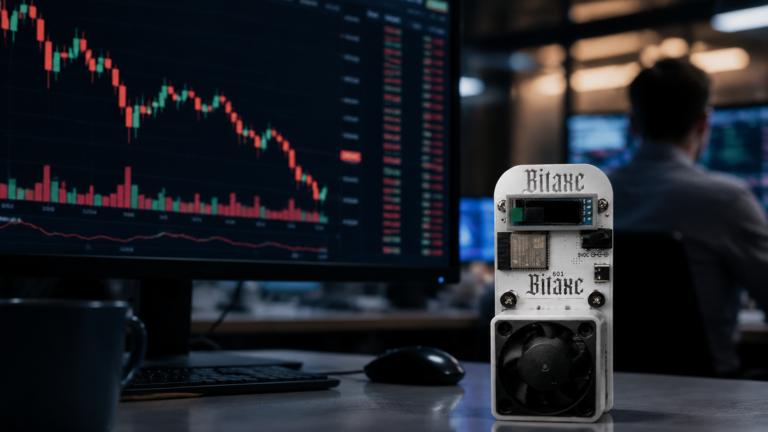

Bitcoin Bottom in 2026? What This Means for Your Home Mining Setup
Analyst Benjamin Cowen, known for tracking Bitcoin’s cyclical patterns, has updated his forecast for the market bottom. And the timeline might actually be a relief for home miners. While the crypto market grapples with short-term volatility, Cowen’s data points to a specific window: October 2026.
But before you unplug your Bitaxe, let’s translate this macro prediction into a practical playbook for the small-scale, hobbyist miner.

The Cycle Theory: Why October 2026?
Cowen’s analysis is rooted in historical consistency. In previous cycles, Bitcoin’s peak has aligned almost perfectly with the halving timeline, and the subsequent bottom has followed roughly one year after the top.
“The base case is that Bitcoin will bottom around the same time it did in the prior two cycles—about a year after the top,” Cowen stated. “The most likely scenario right now is October 2026.”
For context, this isn’t about a specific price number. It’s about time spent in the trough. Historically, the worst of the bear market has been a drawn-out, sideways chop rather than a single-day crash.
The Alternative: A Painful Crash to the Bottom by May?
Cowen did offer an alternative scenario: a bottom arriving much earlier, perhaps by May of this year. However, he was quick to note the catch.
“For that to happen, you’d need a decline that is far more violent than anything we’ve seen in mid-cycle years historically,” he explained.
Essentially, a May bottom would require a catastrophic event. Without a significant deviation outside the standard deviation range of mid-cycle returns, Cowen sees no reason to move away from the October 2026 projection. Barring a black swan, we are likely in for a slow grind rather than a sudden cliff.
What This Means for Home Miners (Not Institutions)
Here is where the narrative diverges for someone running a Bitaxe compared to a Wall Street fund manager.
- Hashrate and Difficulty Lag: When prices drop, large industrial miners sometimes unplug unprofitable machines. This lowers the network hashrate and, consequently, the mining difficulty. For home miners, a lower difficulty means your small ASIC chip finds shares slightly more often. You are competing against fewer giant warehouses.
- The Solo Mining Lottery: A bear market is historically a fantastic time to solo mine. Why? Because the lower the difficulty, the higher the mathematical chance your single Bitaxe Gamma has of hitting a solo block. It’s still a lottery, but the ticket price (electricity cost) is lower relative to the potential reward.
- Emotional Stagnation: The hardest part of the October 2026 prediction isn’t the price drop; it’s the boredom. The market may drift sideways for 18 months. For a hobbyist, this is actually perfect. You can let the fan hum quietly in the background without checking the price every five minutes.
3 Things a Bitaxe Owner Should Do Now
Instead of trying to time the exact bottom price, focus on operational efficiency and stacking strategy.
1. Optimize Your Electricity Costs
If the bottom is a year and a half away, your profitability depends solely on wattage. Now is the time to update to the latest open-source firmware (like AxeOS) and fine-tune your frequency and voltage settings. Even shaving 1W off your power draw compounds over 500+ days.
2. Focus on “Time in the Market,” Not “Timing the Market”
With a Bitaxe, you aren’t mining a full Bitcoin a day. You are stacking satoshis (sats). In a bear market, the sats you earn today might be worth less in fiat tomorrow, but they are still KYC-free Bitcoin. If you believe Bitcoin will reach new highs in the next cycle (2028-2029), the sats you mine during the 2026 lull will be the most valuable sats you ever acquired.
3. Tune Out the Noise
If you find yourself checking charts daily and feeling anxious, remember the thesis: October 2026 is the current best guess for the bottom. The path there is likely choppy and boring. This is the ideal environment to let your open-source hardware do what it does best—validate transactions silently and efficiently—while you focus on learning more about the network infrastructure.
Editor’s Take: The Home Miner’s Advantage in a Downturn
Institutional miners have debt covenants and payroll to meet; they are forced to sell Bitcoin into weakness to cover bills. As a home miner with a Bitaxe, you have no such pressure. Your overhead is $10-15 a year in electricity. You are mining lottery tickets with free entry into the Bitcoin network’s long-term security.
If you’re looking for an efficient way to stack sats during the dip, check out the [latest Bitaxe efficiency stats].
Stay cool, keep the fan spinning, and see you at the bottom in 2026.